), describes its Colossus cluster as the world's most powerful AI training system, comprising 200,000 interconnected chips.
Traditionally, the AI chips used to train foundation models are housed in separate servers and communicate over a network to share data and divide workloads. But the new architecture, Peerium, uses a high-speed interconnect system designed to maintain efficient communication between chips across multiple racks, even as the number of chips scales into the hundreds of thousands.
Huawei unveiled the new architecture Sept. 17 at the company's annual CONNECT conference.
"Over the next two years, there will be roughly 6 or 7 frontier AI labs in China, and all will aim at training foundation language models of sizes ranging from 10 to 40 trillion parameters," Liao Heng, chief scientist for Huawei's chip design arm HiSilicon, told the Associated Press. "So you need such a scale of infrastructure to train these models."
Peerium's performance relies on three elements: nested parallelism, unified memory addressing, and peer-to-peer interconnects, Huawei representatives said in the statement.
Nested parallelism allows workloads to be broken into smaller tasks and organized across hierarchical groups of chips that work in parallel. It's similar to how a company breaks down work into departments and then smaller teams, all of which coordinate their efforts toward a common goal. Unified memory addressing allows processors to access memory across other servers, as opposed to only that attached to the processor's own server. Peer-to-peer interconnects allow components to communicate more directly with one another, rather than relying on an intermediary.
All three principles are designed to make more efficient use of computing resources so that a single system can coordinate larger numbers of chips to handle demanding AI workloads.
According to Huawei, existing interconnect technologies — which link processors and servers to enable them to communicate — cannot support the Peerium architecture at the scale it envisages. For instance, NVIDIA uses NVLink for communication within racks and InfiniBand for communication between racks. The inter-rack communication bandwidth in this setup is 200GB per second, Eric Xu, Huawei's rotating chairman, told the AP.
"With such a low inter-rack communications bandwidth, there is no way you can make one million processors work as one computer," he said.
Huawei instead developed its own interconnect technology, UnifiedBus, which the company says delivers inter-rack communications bandwidth of up to 800GB per second.
"When one million processors work as one computer, this lays the foundation for better and more efficient AI training and inference," Xu added. "Therefore, I see UnifiedBus as the path for the future AI era. I believe, in the years to come, other players would certainly follow suit."
Alongside Peerium, Huawei also announced the Atlas 950 SuperPoD, a computing system built on Peerium and powered by more than 8,000 Huawei Ascend 950DT AI accelerator chips.
Xu said testing for AI training is underway on these SuperPoDs and that results show that they use their available computing power for AI training more efficiently than AI computing clusters that aren’t based on Peerium and UnifiedBus.
Huawei expects to begin supplying the SuperPoDs by early next year, at the latest, before its SuperClusters, which link multiple SuperPoDs to form a larger AI computing system, based on Peerium, eventually come online. Representatives said that one SuperCluster with 256,000 computing cards — hardware modules that add processing capacity — is currently being deployed and tested.
Models with large numbers of parameters demand greater computing resources and infrastructure, which isn't always desirable as it increases costs. In the summer, researchers used an IBM quantum computer to reduce the perplexity of Meta's Llama 3.1 8B language model — a measure of how well it predicts the next word or token — while keeping the number of parameters almost unchanged.
'> Huawei unveils 'SuperCluster' architecture designed to make 1 million AI chips work as a single computer
According to a new theoretical study, sheet-like structures in the gravitational field can break apart and reconnect in new arrangements, much like the magnetic field lines that unleash solar flares.
Built entirely on Albert Einstein's theory of general relativity, the study spells out when this "gravitational reconnection" can happen. It also offers a way to measure how fast the theoretical reconnection proceeds, and suggests a change to how gravity and matter trade energy. The process could even play a role in black hole collisions, the researchers suggest.
From solar flares to space-time
Magnetic field lines are normally "frozen" into plasma — the hot, electrically charged gas that makes up stars — and carried along wherever it flows. The lines can be stretched and twisted, but not cut. Where this rule breaks down, they can snap and rejoin in a process called magnetic reconnection, releasing pent-up energy in explosive bursts such as solar flares.
"In plasma physics, reconnection has become an essential part of our understanding of how magnetic fields reorganize and exchange energy with matter," Luca Comisso, an astrophysicist at Columbia University and first author of the study, told Live Science via email. "Could something similar be true for gravity?"
"Gravity and magnetism describe very different aspects of nature, so there's no obvious reason to expect them to behave alike," Comisso said. "But when we express Einstein's equations in a particular mathematical form, some of the same principles that govern magnetic fields also emerge in gravity. We wanted to understand whether those similarities extended to reconnection itself."
Comisso and study co-author Felipe Asenjo, a physicist at Adolfo Ibáñez University in Chile, used a mathematical framework known as the tetrad formulation. "Einstein's theory describes gravity through the geometry of space-time," Comisso explained. But in the tetrad formulation, "certain aspects of gravity can be expressed through quantities resembling electric and magnetic fields."
In a prior study published in the journal Physical Review Letters earlier this year, the researchers applied this framework to gravity. That study suggested that gravitational fields can form two-dimensional structures called gravitational field sheets. Of the sheets' two dimensions, one stretches through space and the other through time — so each sheet is the trail a line leaves as time passes. A snapshot at any instant therefore catches each sheet as a line, akin to the field lines drawn around a magnet. And, like magnetic field lines frozen into a plasma, "under certain conditions, these sheets evolve without breaking or changing how they are connected," Comisso said.
An illustration depicting the sun’s magnetic field lines over an image taken by NASA’s Solar Dynamics Observatory. When magnetic loops get stretched to their limit, they snap and reconnect, triggering solar flares. (Image credit: NASA/SDO/AIA/LMSAL)Rewiring gravity
In the new study, published Oct. 28 in the journal Physical Review D, the researchers found that this is not always the case. "Gravitational field sheets can break and reconnect in a different arrangement, much like magnetic field lines do in plasmas," Comisso said.
The researchers showed that breaking the frozen-in rule doesn't, by itself, guarantee reconnection. Sometimes, the sheets merely slip relative to the flow that carries them, staying intact because they remain frozen into a different flow. Genuine reconnection happens only when no such alternative flow exists.
"We also derived equations describing how quickly this reconnection can occur and how it can affect the transfer of energy and momentum," Comisso said. In general relativity, gravity and matter can trade energy and momentum, with only their combined total conserved. The study shows that reconnection changes the local rate of that exchange.
Reconnection also alters gravitational helicity, the gravitational counterpart of a quantity that measures how twisted and interlinked magnetic field lines are. Frozen-in sheets keep their helicity fixed, but reconnection can create or destroy it.
The findings don't require new physics. "Everything follows from Einstein's general relativity," Comisso said.
"Einstein developed his theory more than a century ago, and it has passed an extraordinary number of experimental tests," he added. "Yet even after more than a century, there are still new insights to be gained from those same equations."
Clues from colliding black holes
What could trigger gravitational reconnection in nature remains an open question. Among the candidates the researchers suggested are the singularities thought to lurk at the hearts of black holes and the combined effect of gravitational ripples that are too small to track individually. Quantum effects linked to Hawking radiation — the faint glow that black holes are predicted to emit — could also play a part.
"We're still at the beginning, but one of the most interesting possibilities is that gravitational reconnection could play a role in extreme events, such as the merger of two black holes or the collision of neutron stars," Comisso said. "These are environments where gravity is extremely strong and the geometry of spacetime changes dramatically."
Such collisions send out ripples in space-time called gravitational waves, which detectors such as LIGO (the Laser Interferometer Gravitational-Wave Observatory) have been recording since 2015. "We'd like to understand whether gravitational reconnection could contribute to transferring energy, and whether it might leave a recognizable signature in gravitational waves," Comisso added. "We don't know the answers yet, but these are questions that we can now begin to investigate."
'> Gravity can reconnect like the sun's magnetic field, a fresh look at Einstein's equations reveals With 2K image quality, a light pollution filter and a user-friendly interface, it's a smart telescope that anyone can enjoy, regardless of your experience level, and regardless of whether you're shooting from your city balcony or a dark sky site. Like the other models, it uses dual cameras to capture a wide range of subjects, including deep-sky objects with the telephoto camera, and constellations, star trails and the Milky Way with the wide-angle camera. It's lightweight and easy to travel with, and it even comes with a separate solar filter for solar imaging and eclipse time-lapses.
We got our hands on an advance copy to test ahead of its release, so we put it through its paces on several different celestial subjects.
Design & Setup
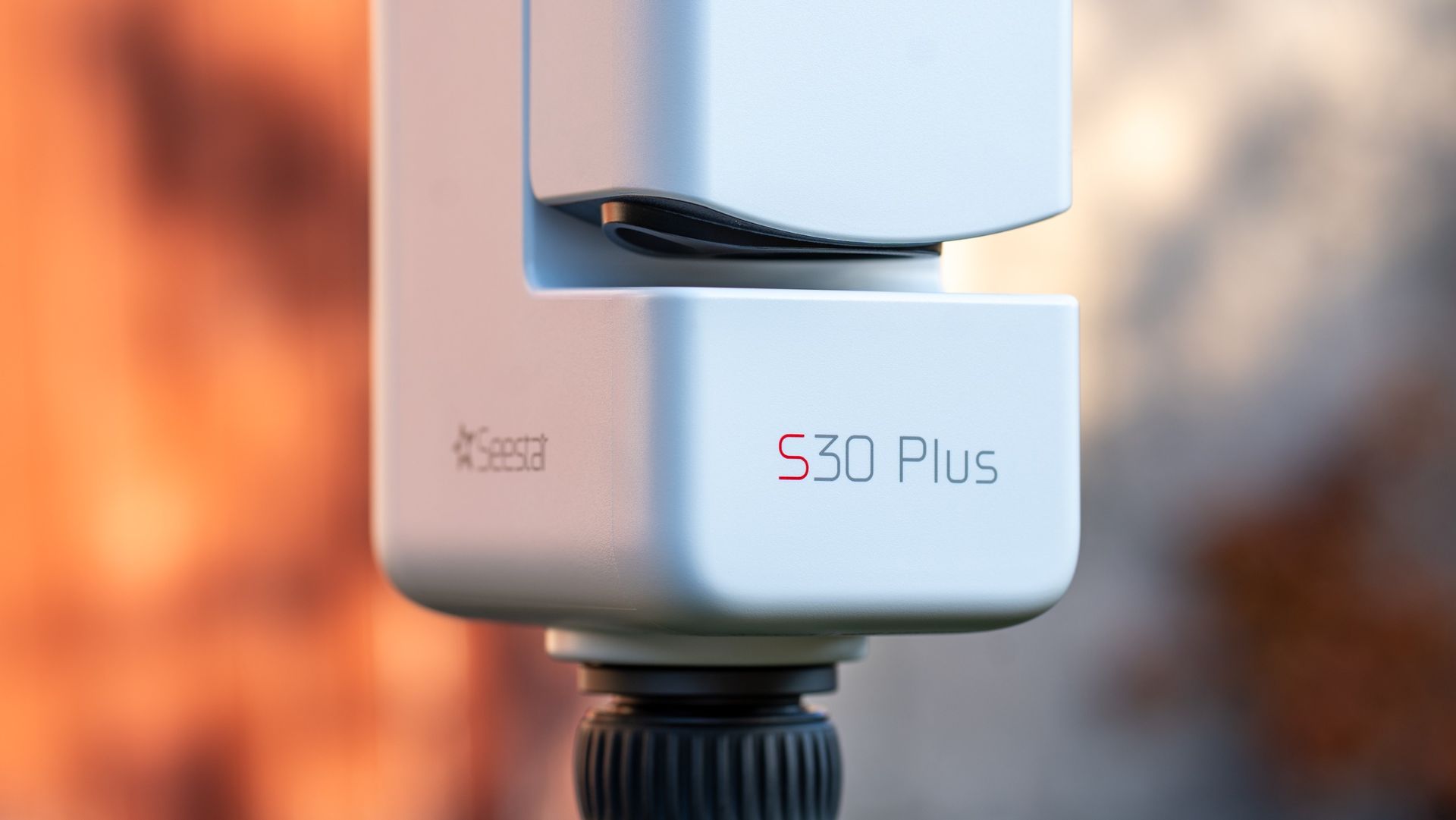 The S30 Plus looks indentical to the S30 Pro, aside from the branding.Kimberley Lane
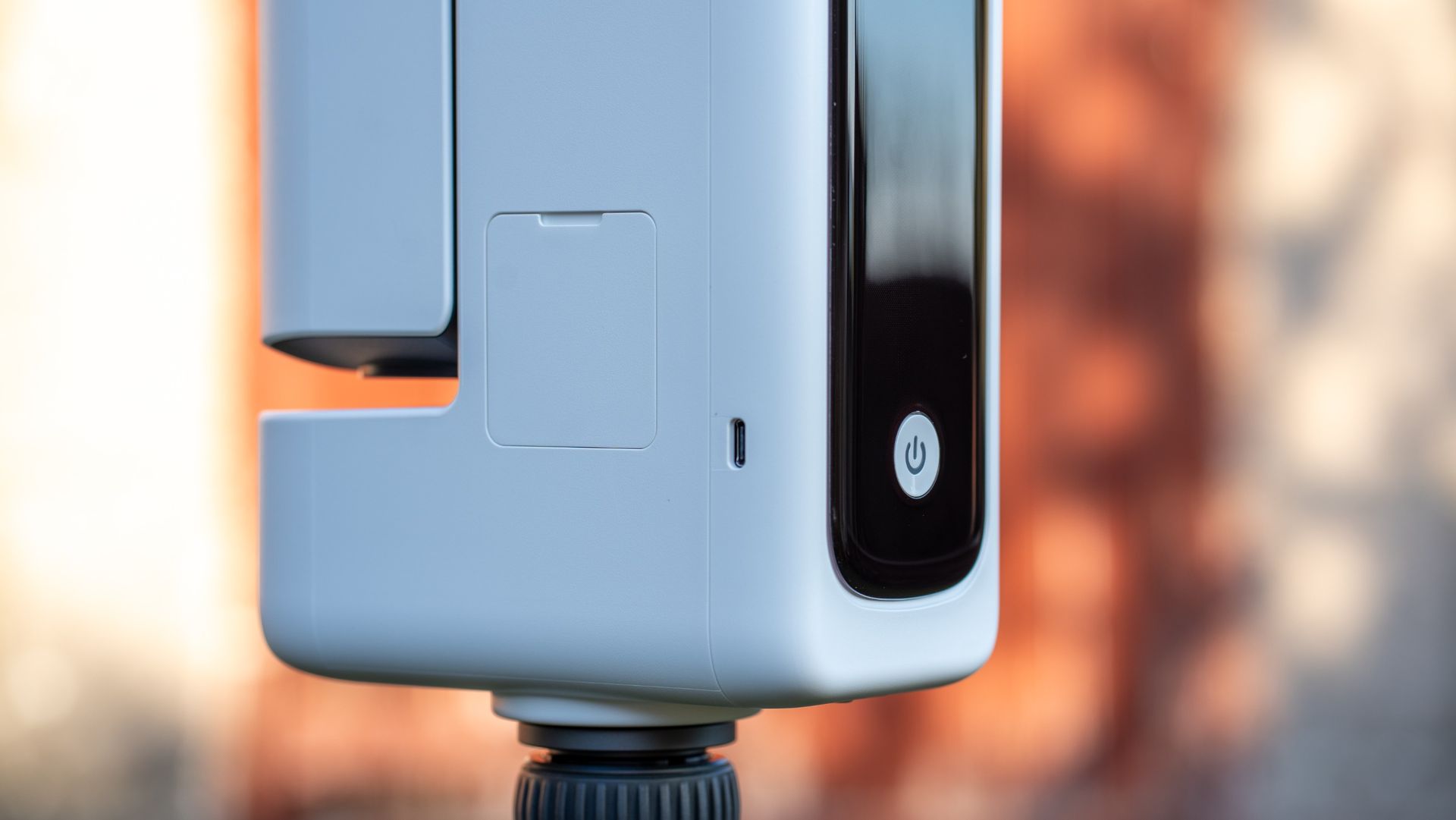 It features a power button and a USB-C port.Kimberley Lane
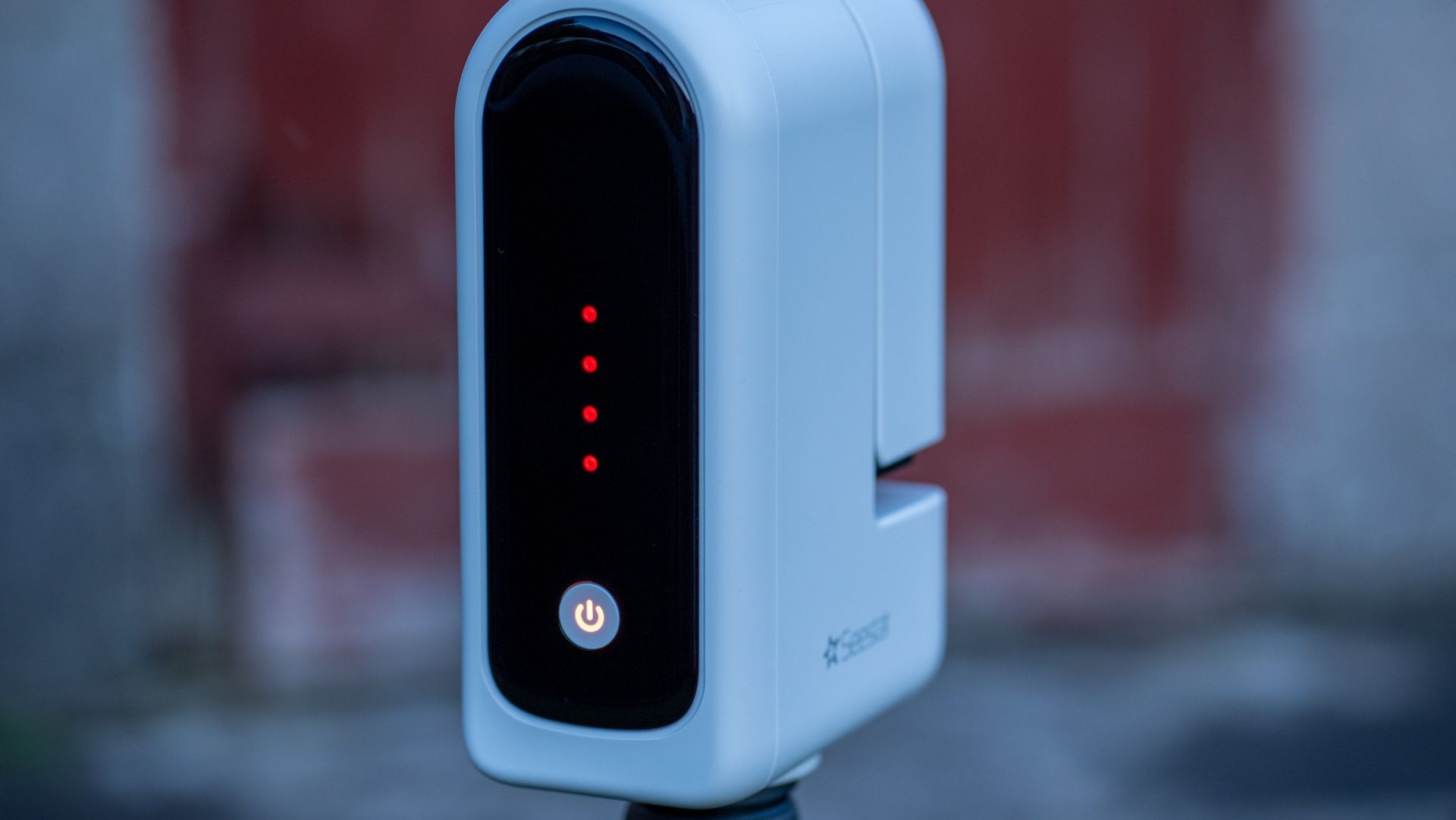 The red LED lights on the front indicate the battery level.Kimberley Lane
- Quick and easy set-up
- Comes with carry case, tripod and solar filter
- Lightweight and easy to transport
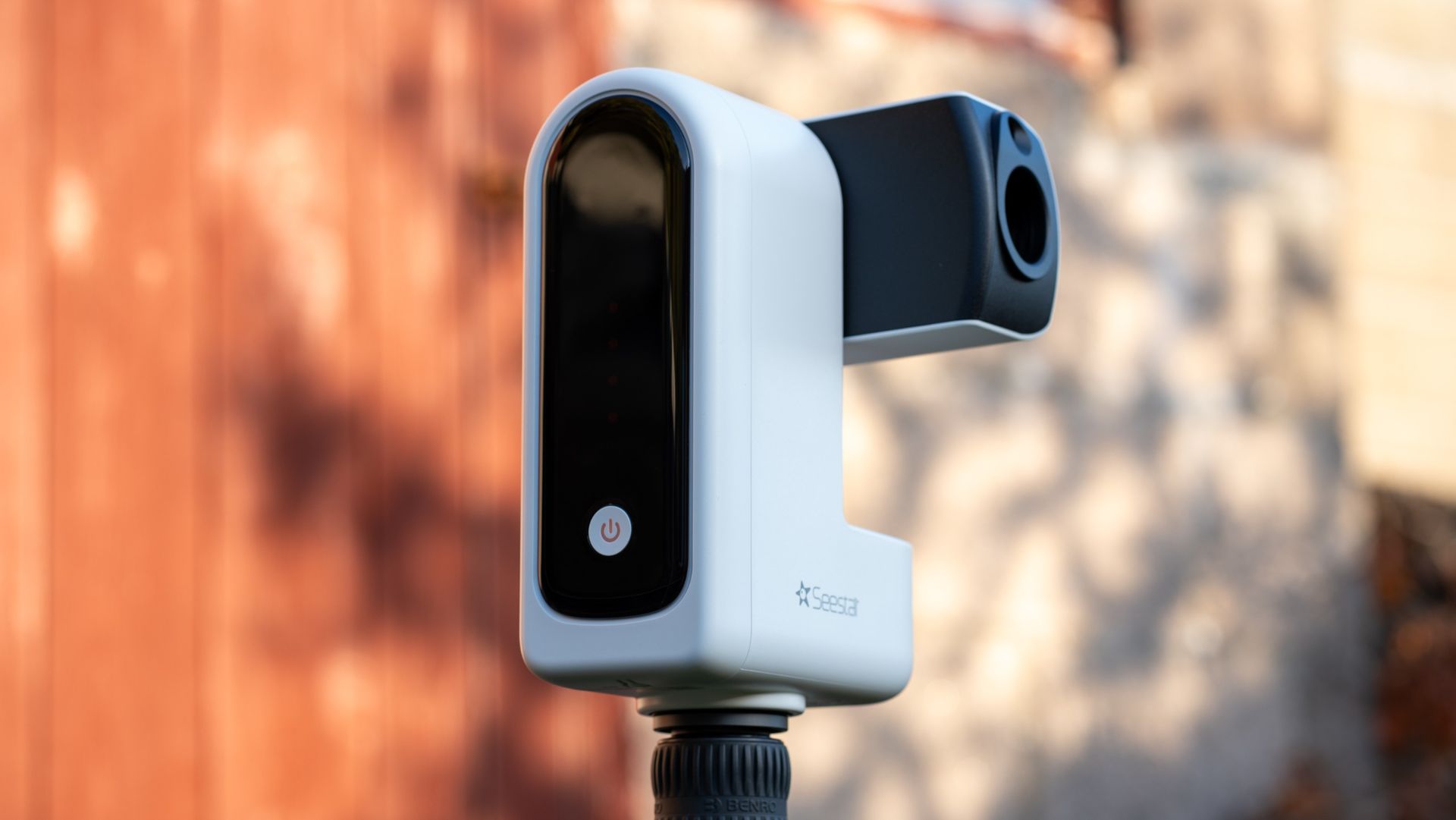
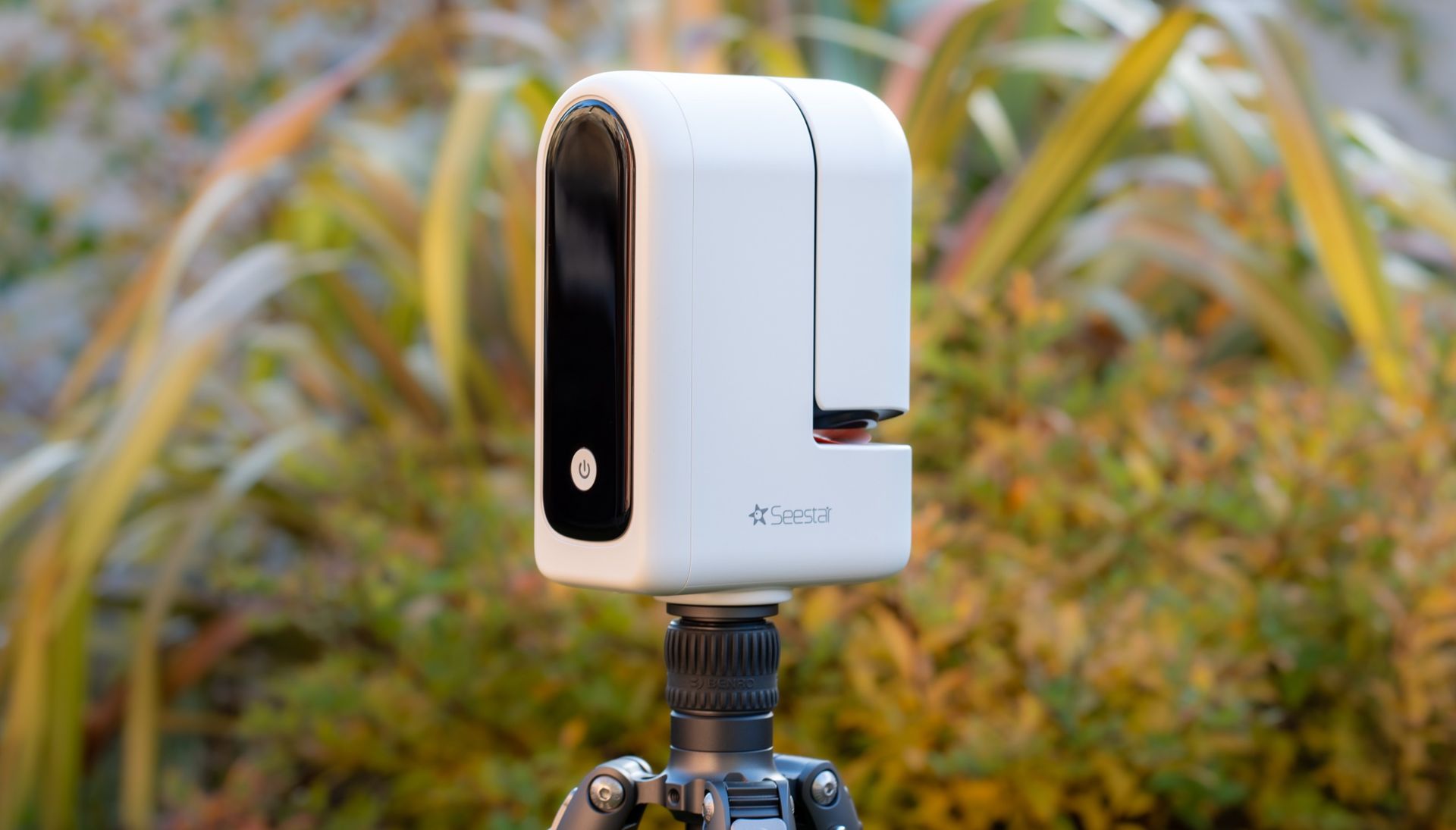
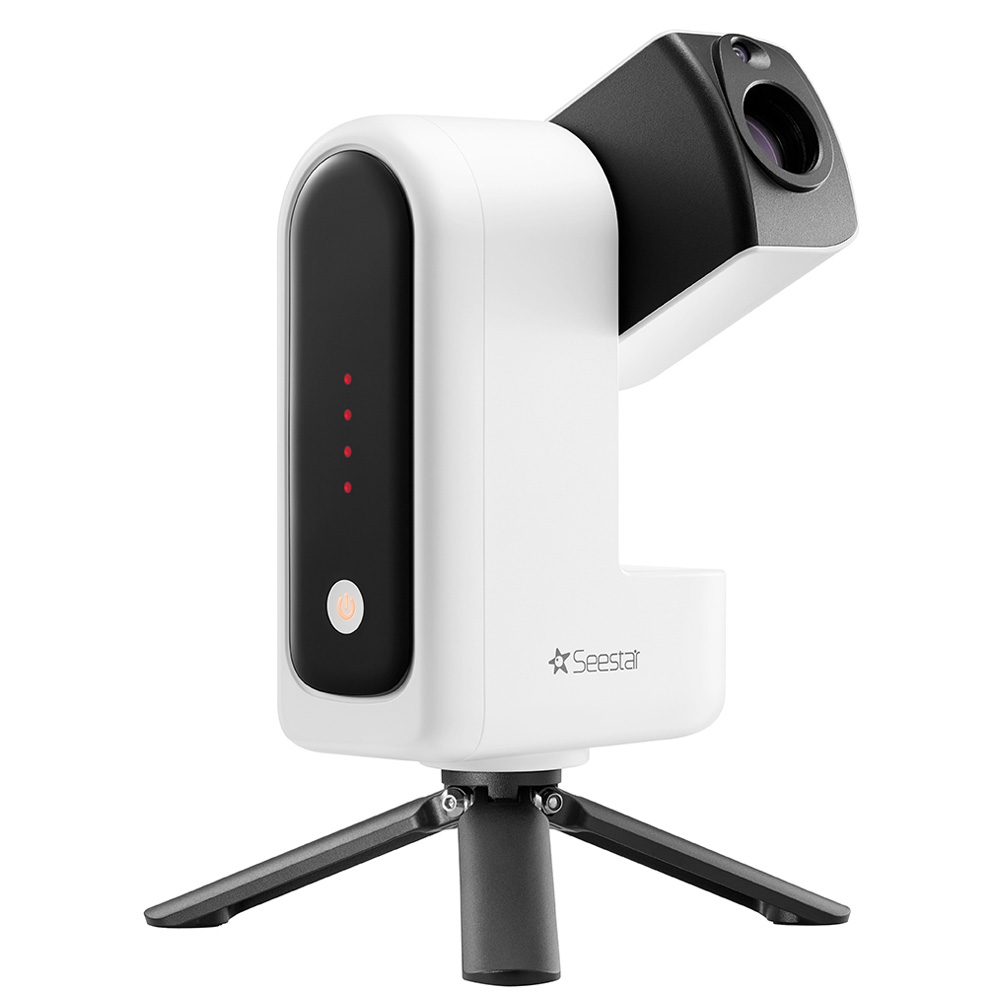
The Seestar S30 Plus is one of the smallest, most compact smart telescopes on the market, weighing just 3.63 pounds (1.65 kg) and measuring 8.3 x 5.5 x 3.2 inches (210 x 140 x 80 mm). Its sleek, matte white design looks identical to the other Seestar models (we compared it to our S30 Pro), except for the branding on the unit itself.
It comes in a padded soft carry case and includes a small tripod (although we always prefer to use our own), a solar filter, a 40-inch (1 meter) USB-A to USB-C charging cable, a removable shoulder strap for the carry case, and a quick-start guide. With its accessories and case, the whole setup weighs 4.89 pounds (2.22 kg).
On the unit itself, you'll find just one button, which powers it on, plus the USB-C port on the side. Super simple, although we'd have liked the USB-C port to be covered to prevent moisture or dust from getting in.
It comes with a carry case, strap, USB-C cable and solar filter. (Image credit: Kimberley Lane)The set-up process couldn't be easier. When you turn the telescope on, you'll hear a double beep and see the power button light up alongside the red dots on the black screen to indicate the battery level. Four dots mean the battery is full. The telescope will tell you when it's ready to connect, at which point you can sync it up to the app on your smartphone or tablet. To turn it off, you just select "Shutdown" in the app, which closes the arm and turns the unit off.
It also features an anti-dew heater, which we've found works quite well in mild to moderate humidity. On a couple of our shoots, we noticed a tiny bit of condensation forming on the unit when the humidity was higher, so we wouldn't feel confident leaving it unsupervised for long periods on a particularly dewy evening. (We used the Clear Outside app to monitor the humidity levels.)
The Seestar App
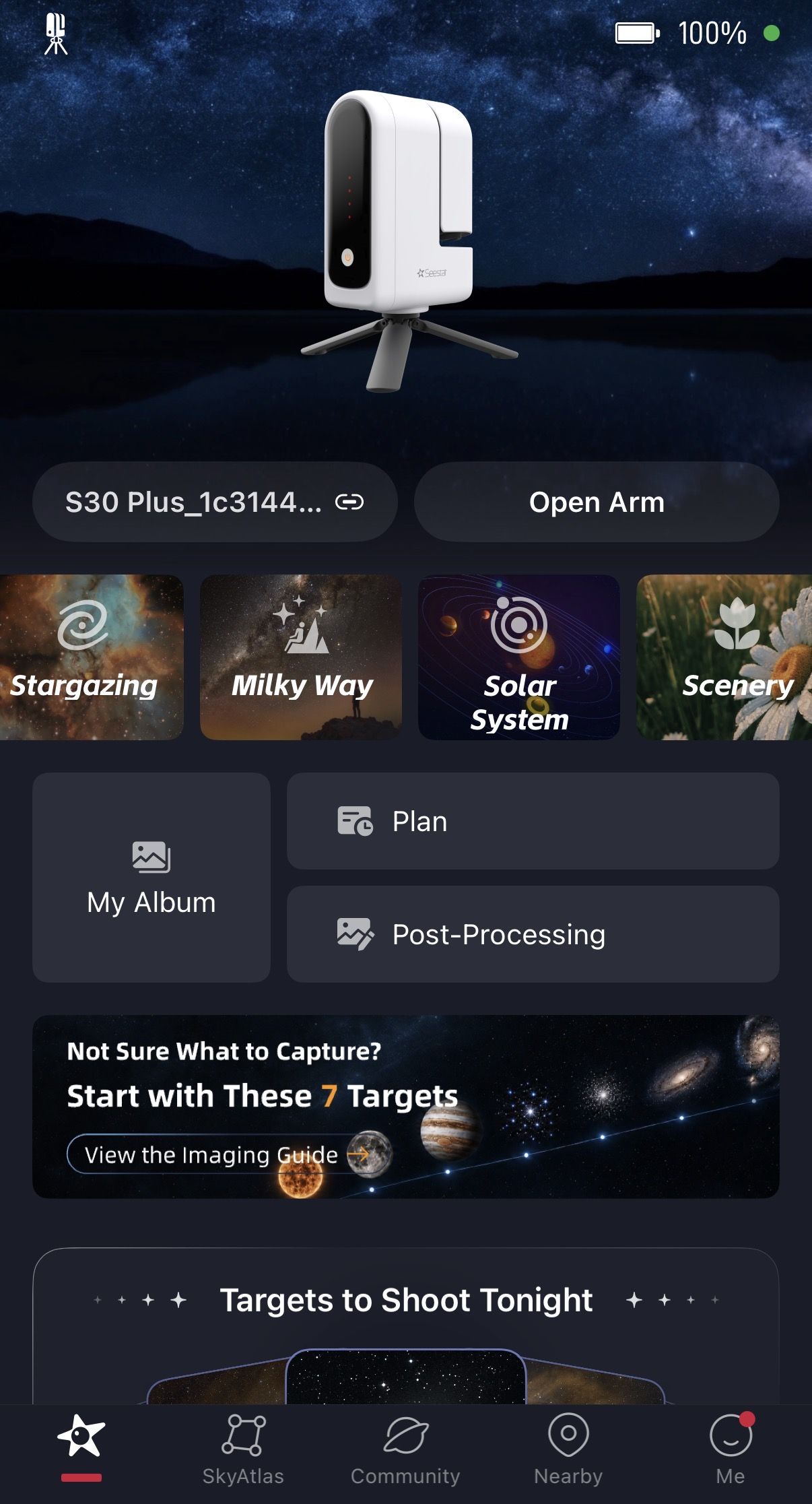 The Stargazing page in the Seestar app.ZWO
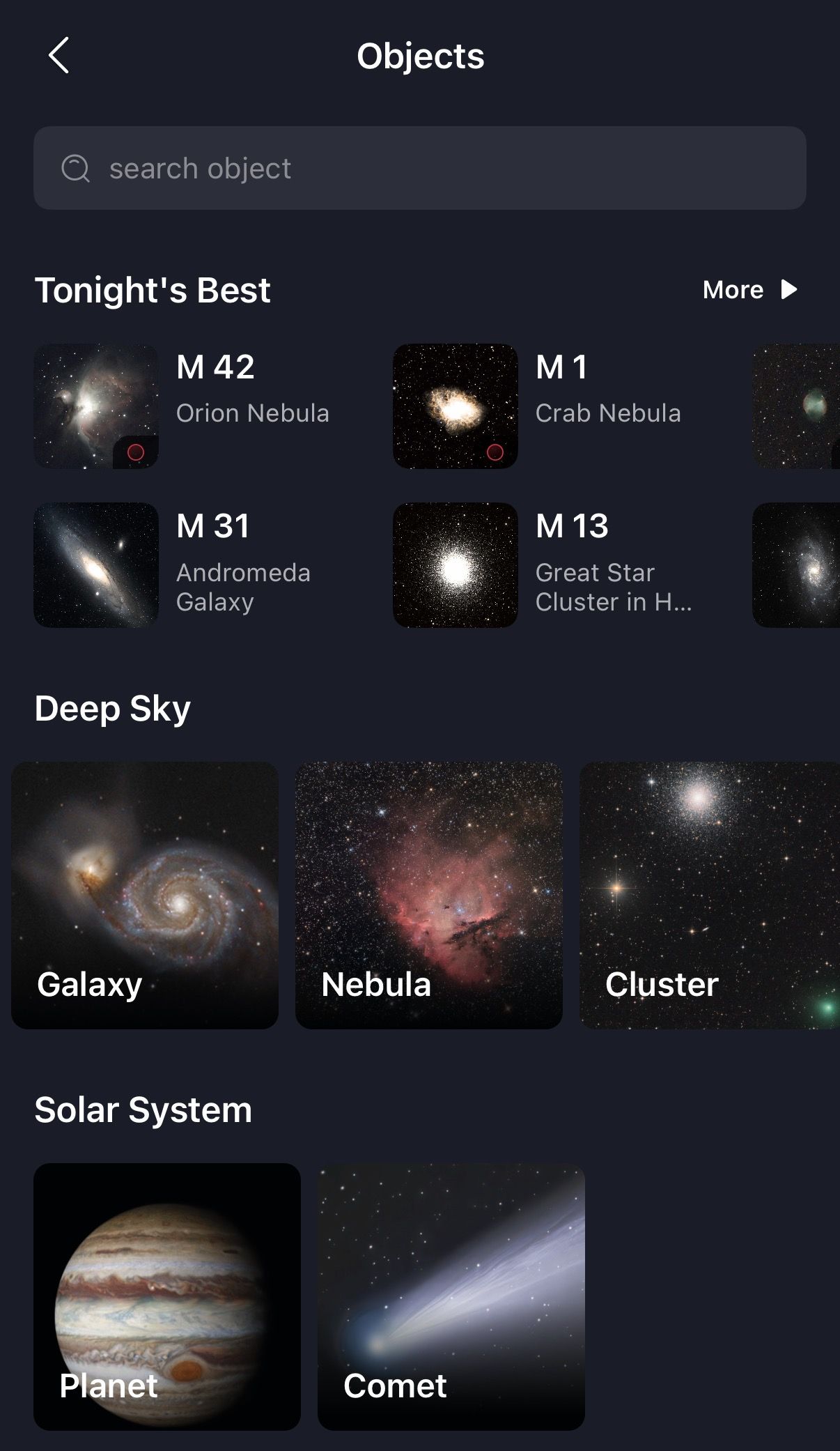 You can browse through objects and see Tonight's Best.ZWO
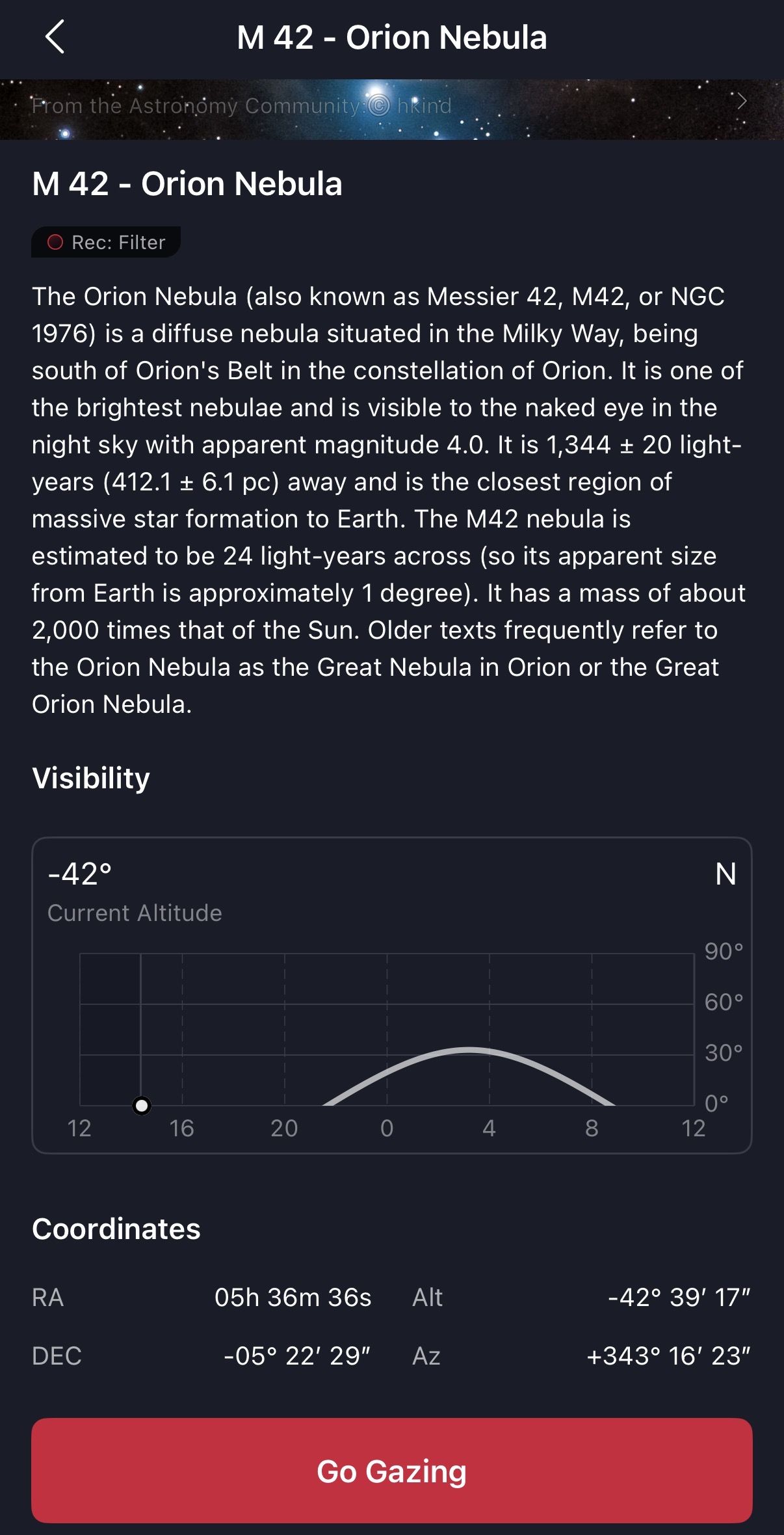 When you click on an object, you'll see information and coordinates.ZWO
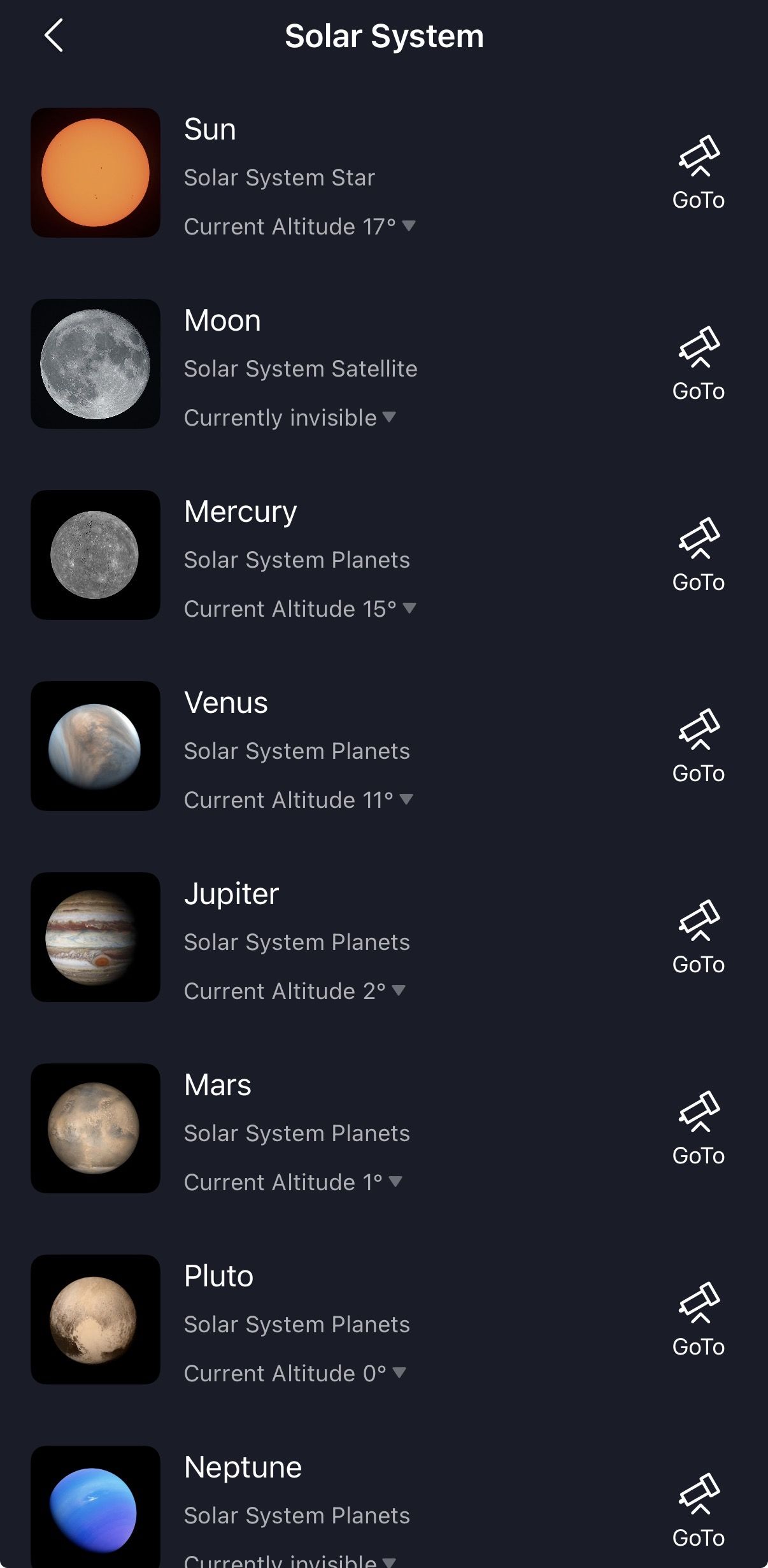 You can also choose objects in the solar system.ZWO
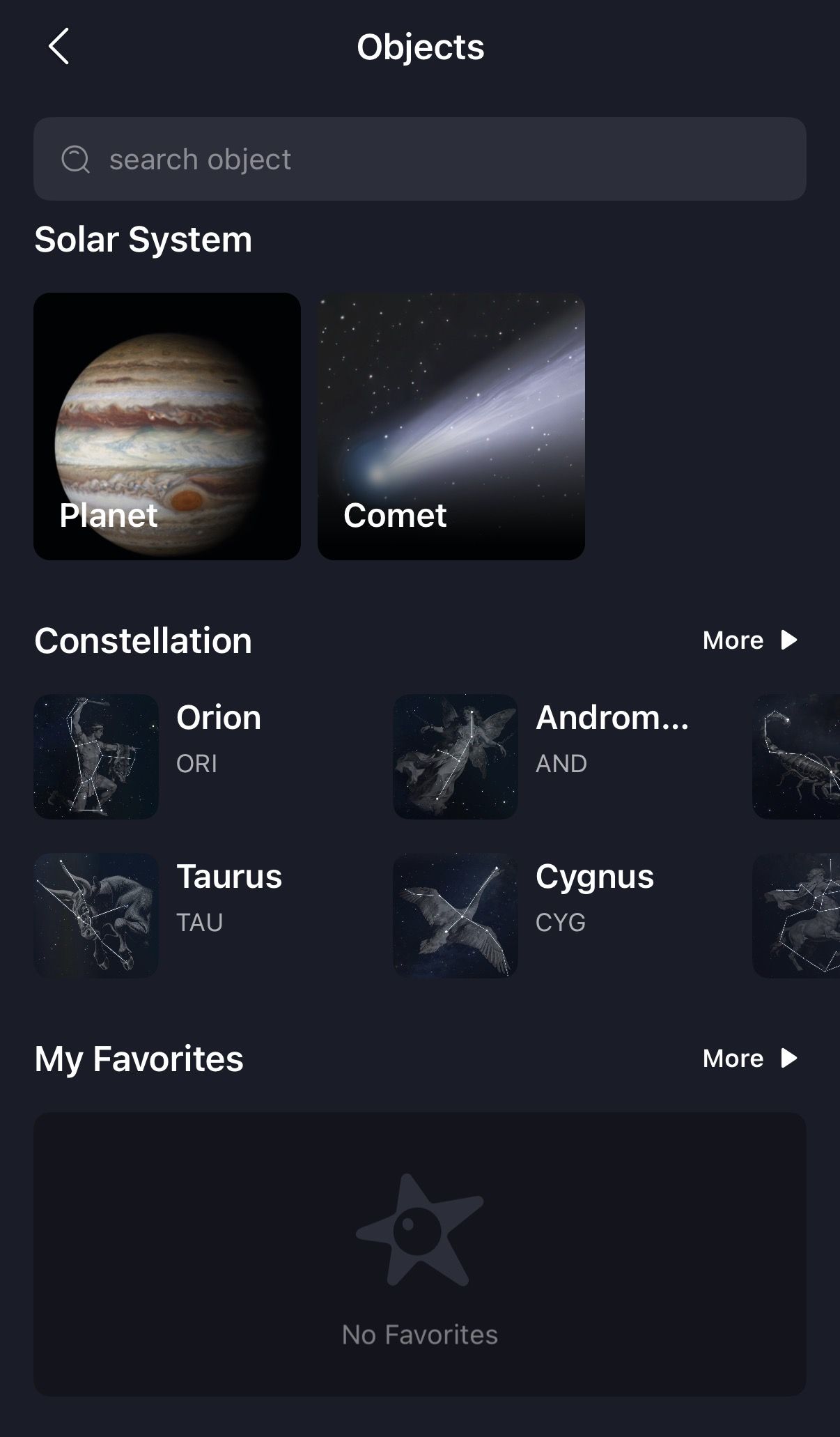 You can image constellations with the wide-angle camera, too.ZWO
- User-friendly and easy to navigate
- A good amount of image editing controls, but we'd like a few more
- Educational and shows what's in the sky for your time and location
The Seestar App is user-friendly and easy to navigate, with just the right amount of controls: you have plenty of options to choose from but it doesn’t become overwhelming. The main Seestar page is where you'll likely spend most of your time, as this is where you can search for celestial objects to shoot, access your album, plan a shoot and read up on what objects Seestar recommends based on your time and location.
The Stargazing section is where you can select or search for the subject you want to shoot. You can use the search function to find a specific target or browse Tonight's Best, and you can also search through different types of subjects like galaxies, nebulas, clusters and more. From here, you can also select planets, track comets and photograph constellations using the wide camera.
Click on a subject and the app will display information about it, including its current altitude and coordinates, which help determine what time is best to shoot that particular object. It automatically applies the appropriate filters and settings, but you can override these if you want to.
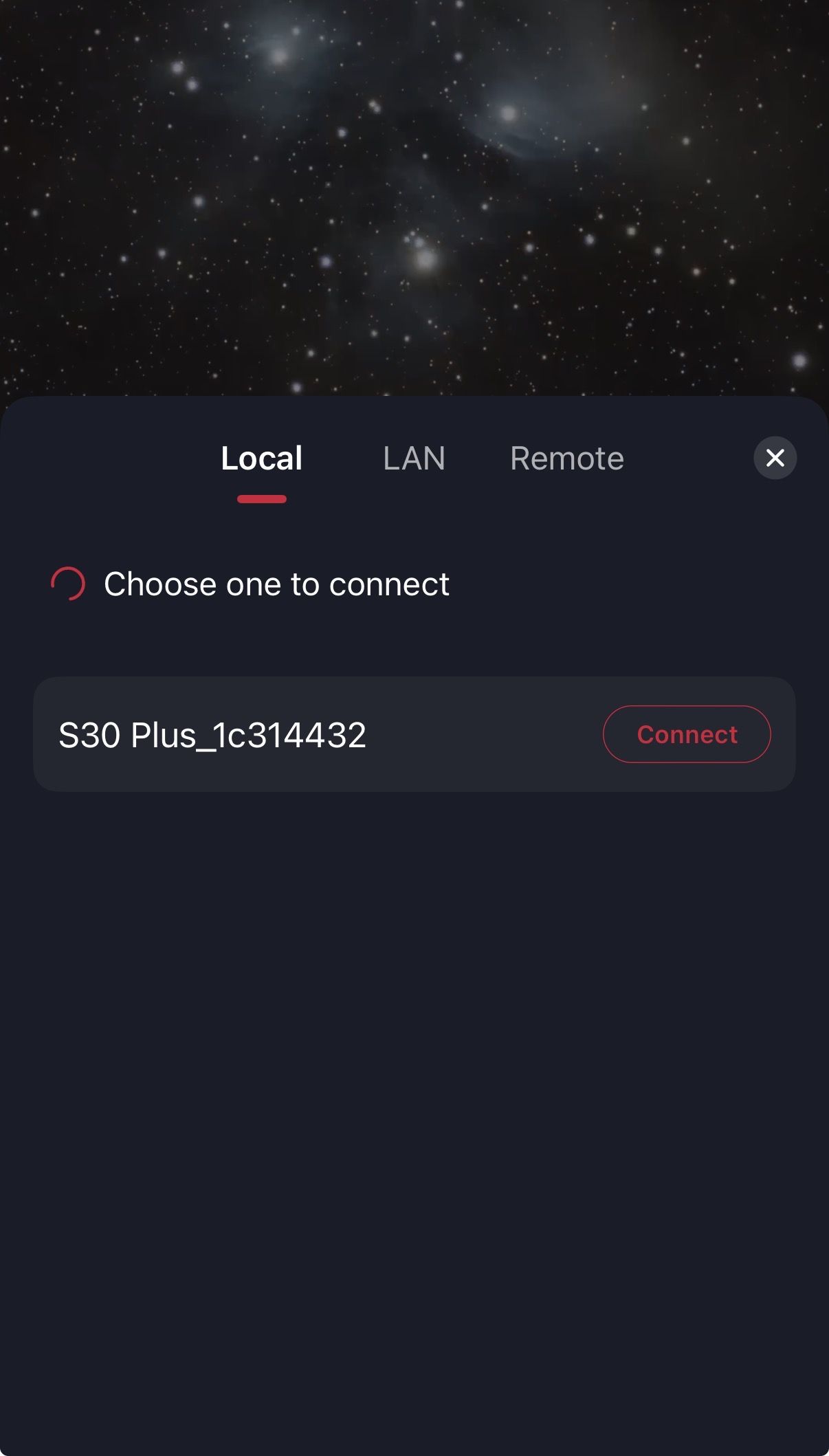 It's easy to connect your phone to the app.ZWO
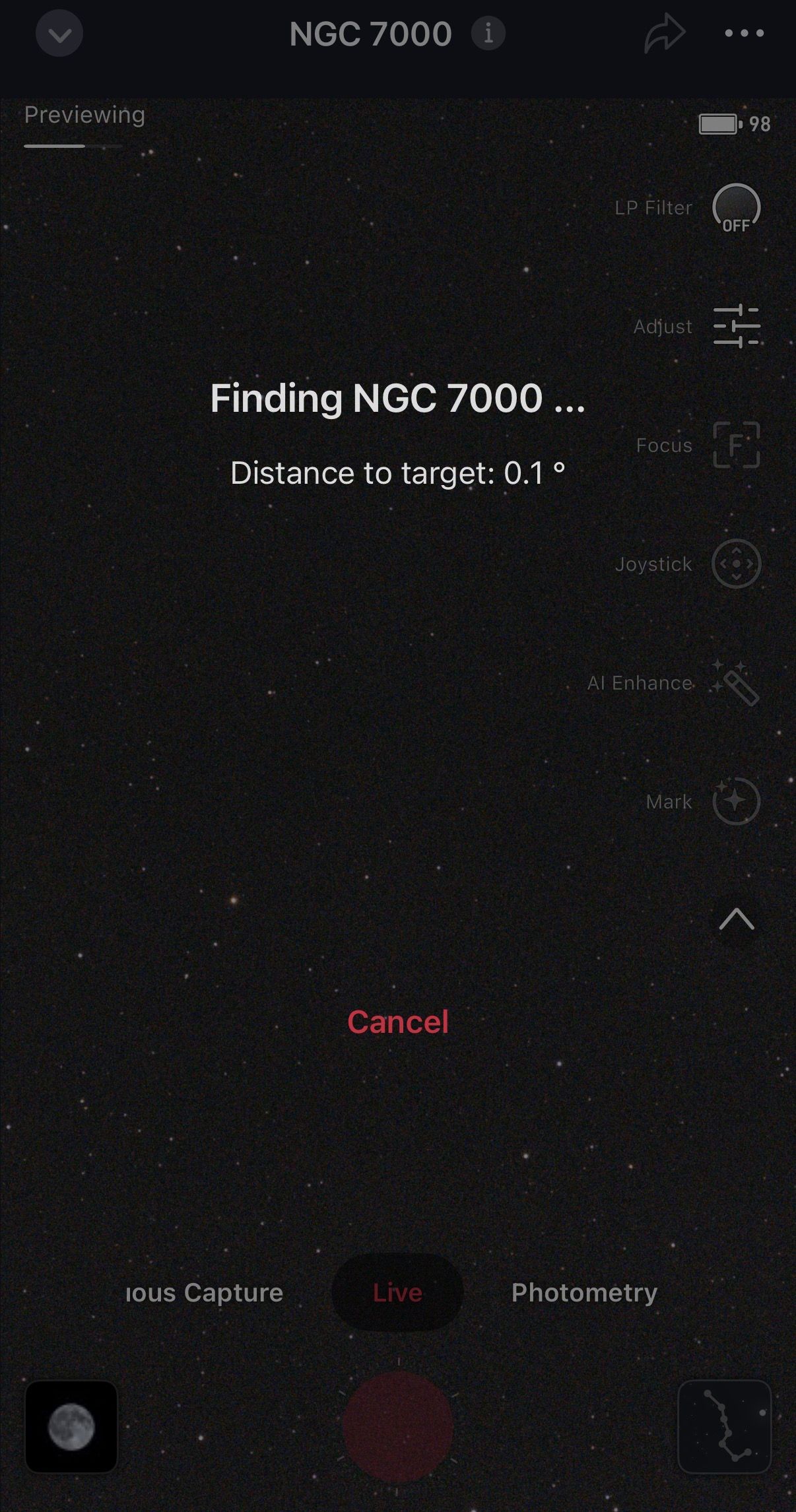 The telescope will show you what it's doing at any given point.ZWO
There's very little to complain about when it comes to using the app. It has lots of information for beginners, so you don't need a ton of knowledge about the night sky, and everything is fairly self-explanatory. There were a couple of occasions when it failed to calibrate itself (for example, when we tried to locate the Pleiades, which had just risen above a tree), and other times when we chose a new target and it slewed the long way round instead of only having to move slightly. But otherwise, the app worked well.
The AI Enhance section has some good editing tools to bring out the best from your photos. You can reduce the stars, adjust the brightness, contrast, saturation and RGB curves, apply denoise and eliminate any satellite trails — although we'd love a dehaze slider to bring out some of the fainter nebulosity of certain objects. The sliders could do with being a little more responsive, especially the RGB curves, but overall, it does a pretty good job of editing your pictures to get a pleasing result.
Astrophotography
- 160mm focal length perfectly suits larger apparent subjects
- Built-in filters to bring out colors
- Modest image resolution, but still pretty good
We had about 10 days to test our review unit before its release, so we could only capture as much as the weather permitted in that time. We'll add more images to this review over the coming weeks. All our tests were conducted from our backyard in a Bortle 4 region, and captured before moonrise to eliminate as much light pollution as possible. Due to these time constraints, we aimed to capture our images for a total of 60 minutes each, although we'd have ideally aimed for longer in some cases.
Now for the fun part — the images. The Seestar S30 Plus has a focal length of 160mm, which is advantageous for capturing large subjects like the Andromeda Galaxy, the North America Nebula and the Pleiades. Large emission nebulas are where it really shines; however, the focal length is too short to capture smaller apparent objects.
For this review, we aimed to capture as many different types of objects as possible. All our images were edited in the Seestar app with, in some cases, a few minor tweaks in Lightroom. You also have the option to download the individual files to your computer to process them yourself in dedicated astrophotography software, which is advantageous if you're a more experienced user.
Star clusters
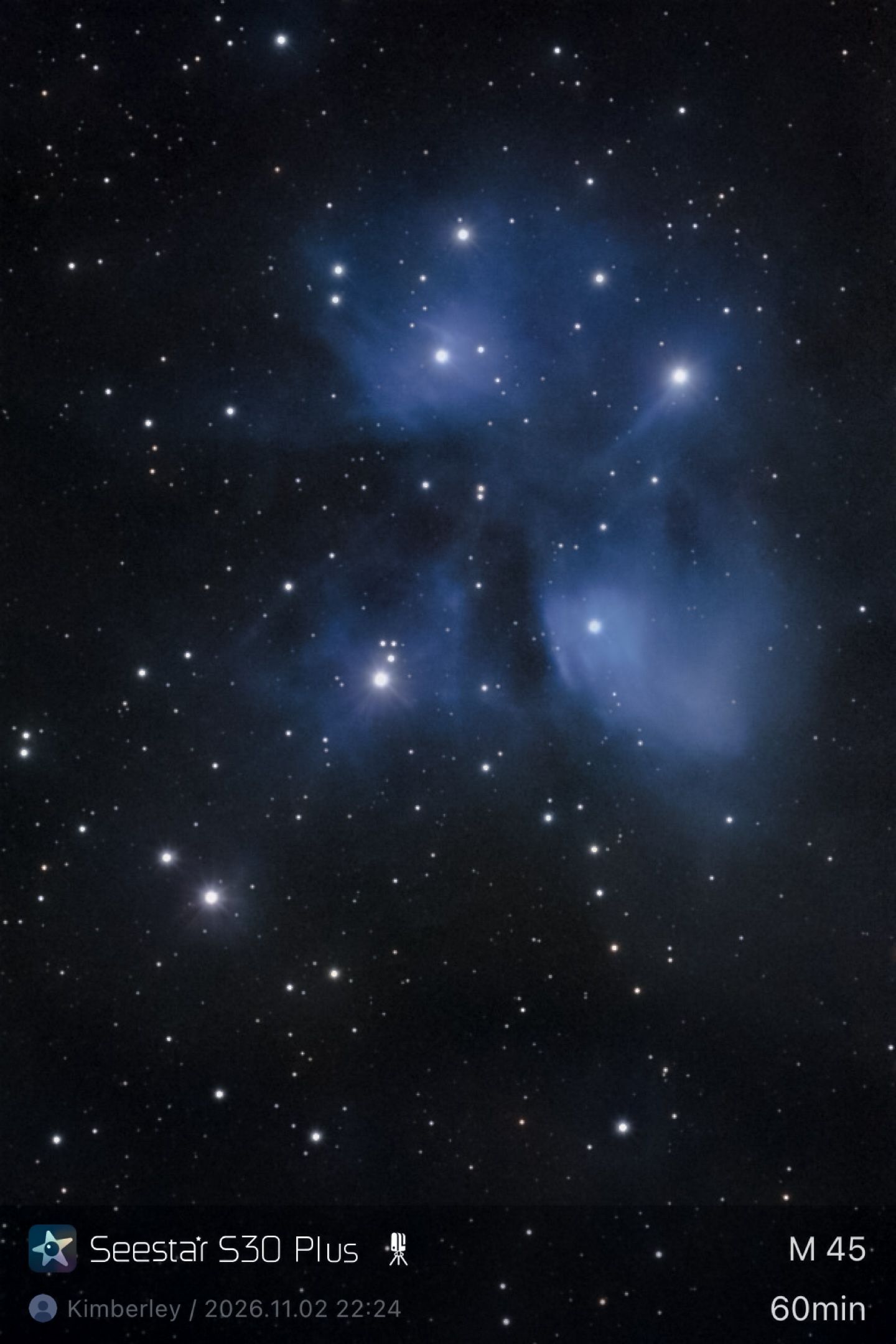 Final M45 images after 60 minutes of integration, with edits in the Seestar app and minor tweaks in Lightroom mobile.App: ZWO Seestar, Image: Kimberley Lane/Future
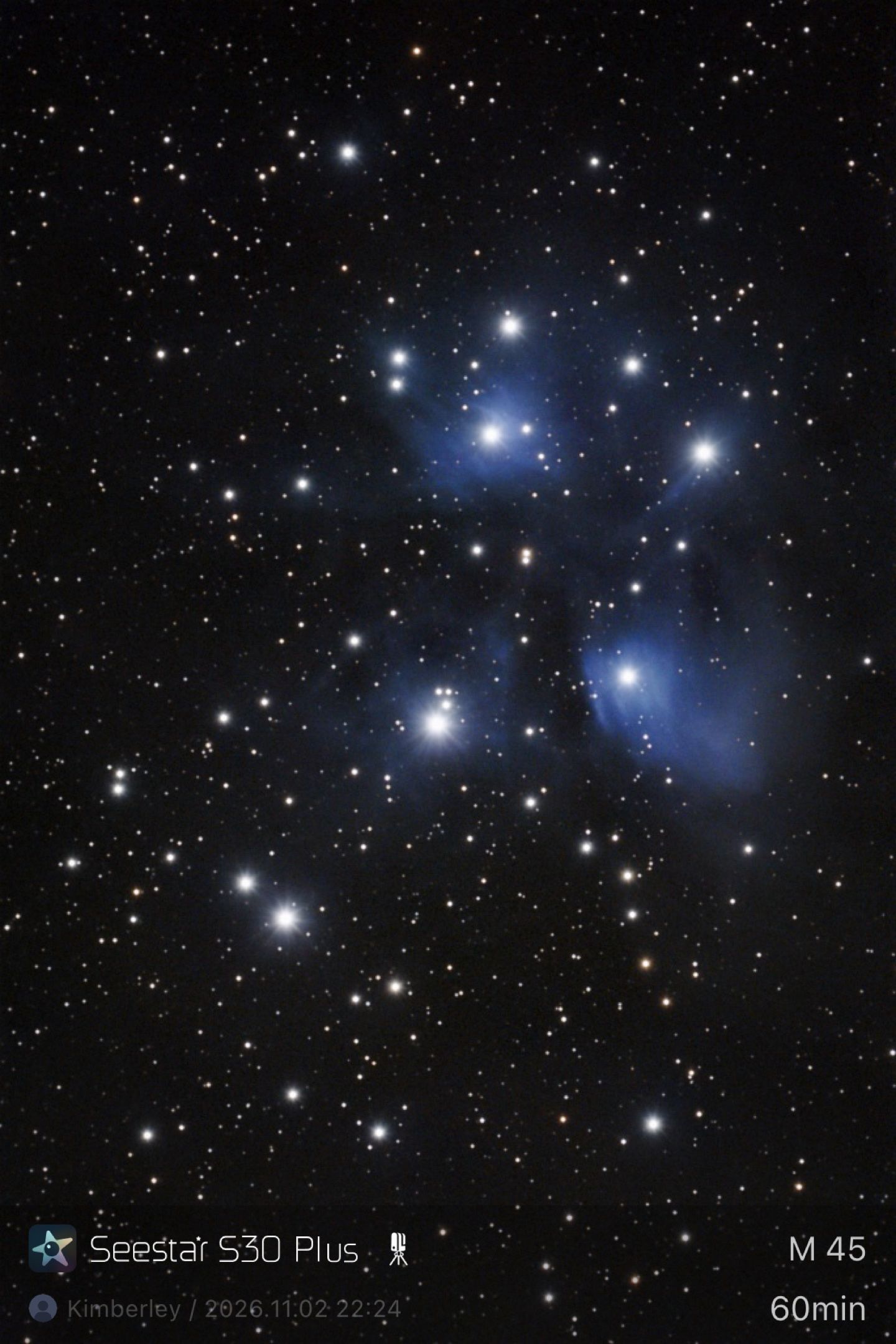 Final M45 images after 60 minutes of integration, edited solely in the Seestar app.App: ZWO Seestar, Image: Kimberley Lane/Future
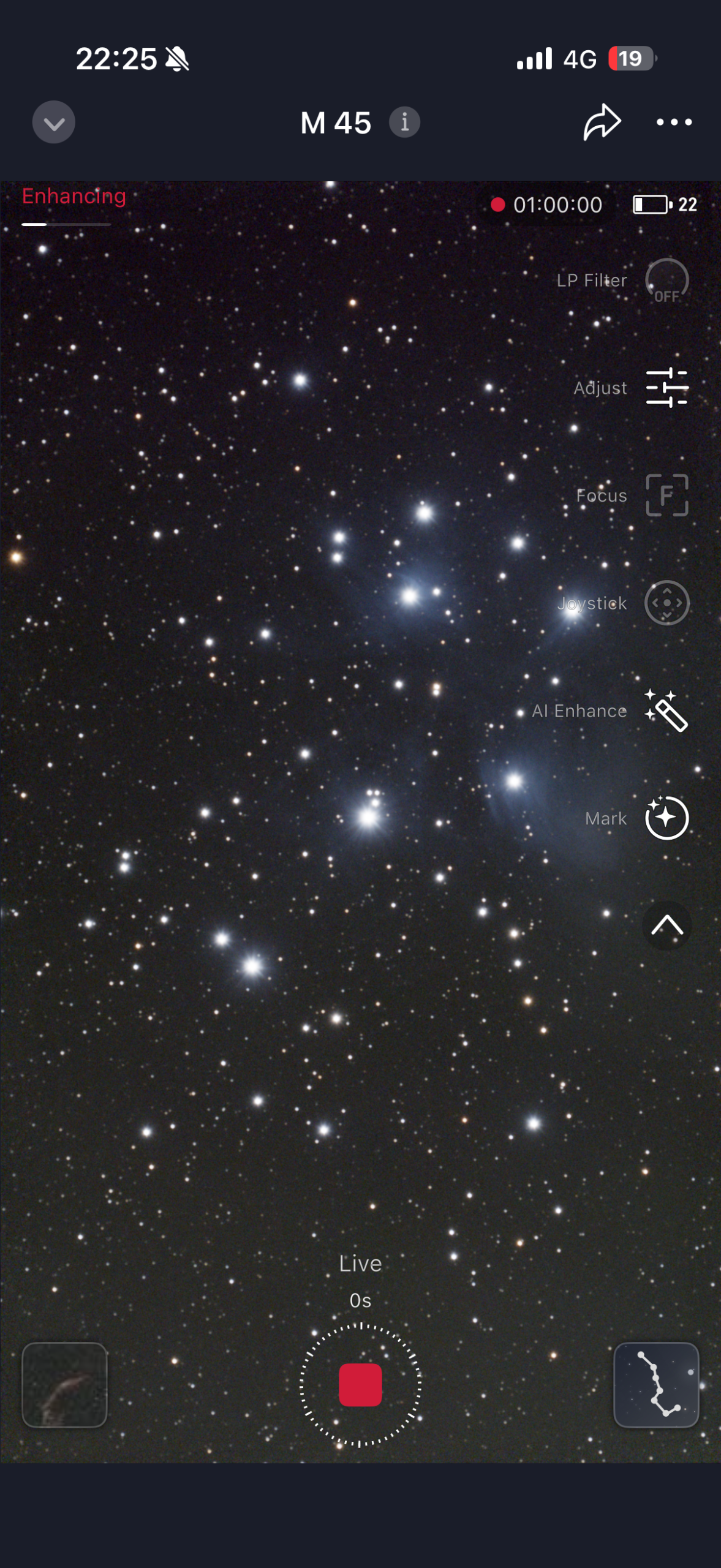 M45 after 15 minutes of integration.App: ZWO Seestar, Image: Kimberley Lane/Future
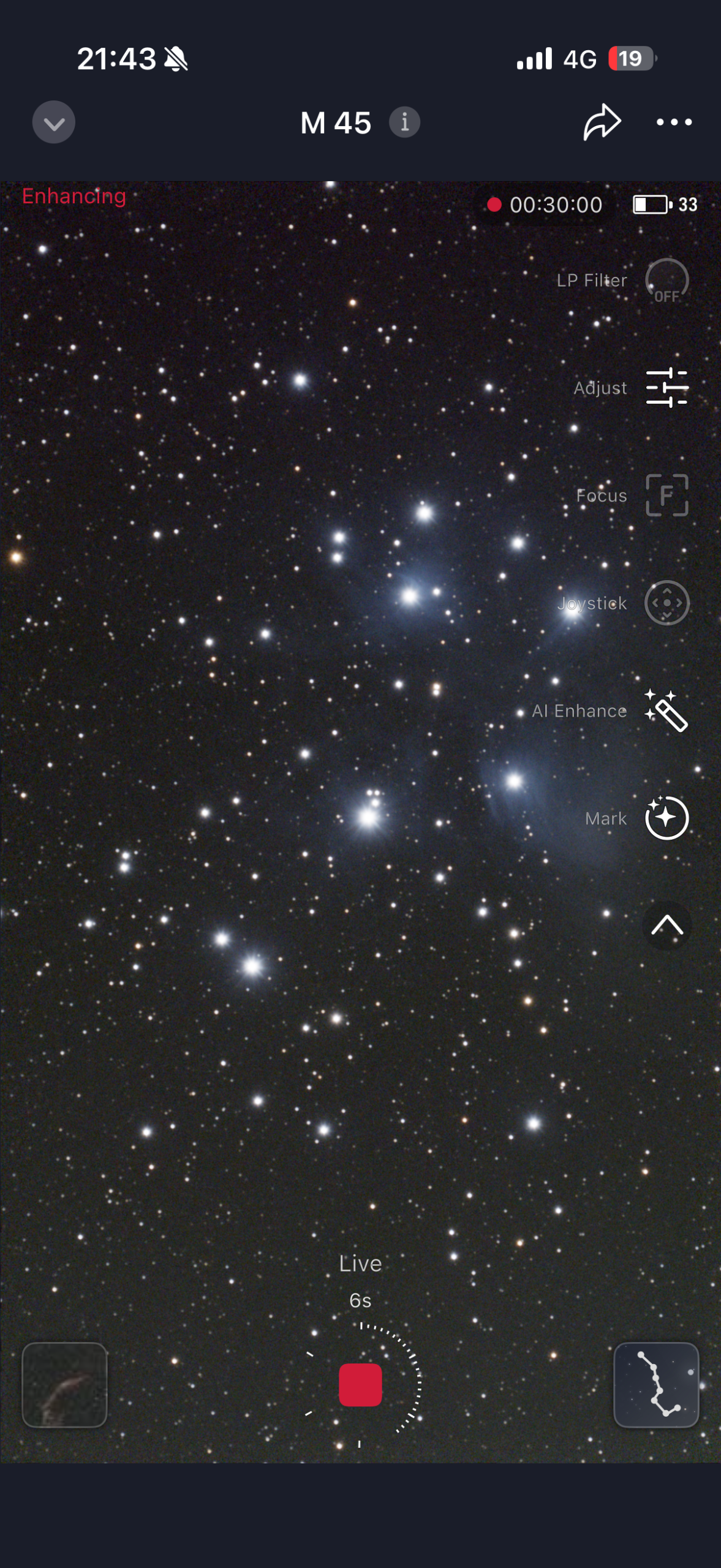 M45 after 30 minutes of integration.App: ZWO Seestar, Image: Kimberley Lane/Future
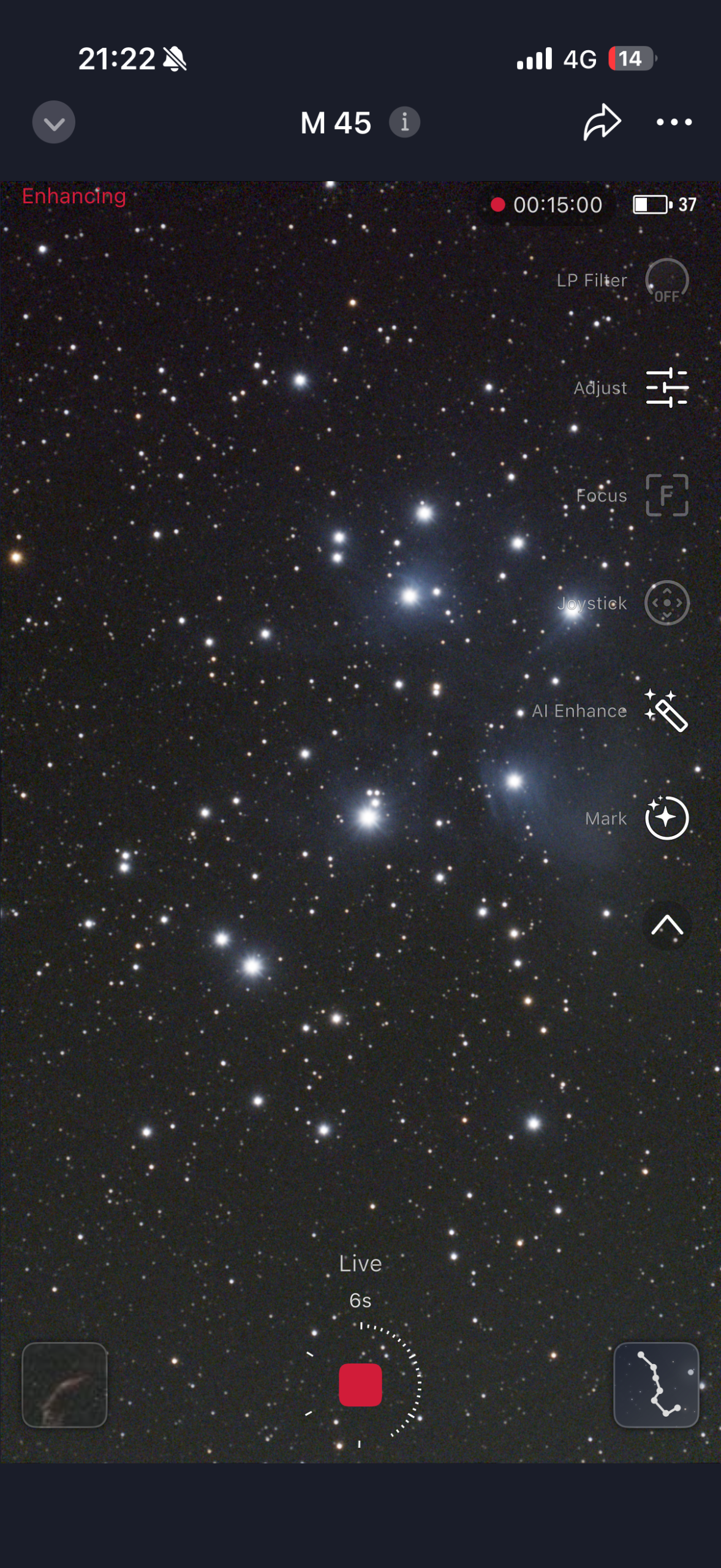 M45 after 60 minutes of integration, as seen in the app with no edits.App: ZWO Seestar, Image: Kimberley Lane/Future
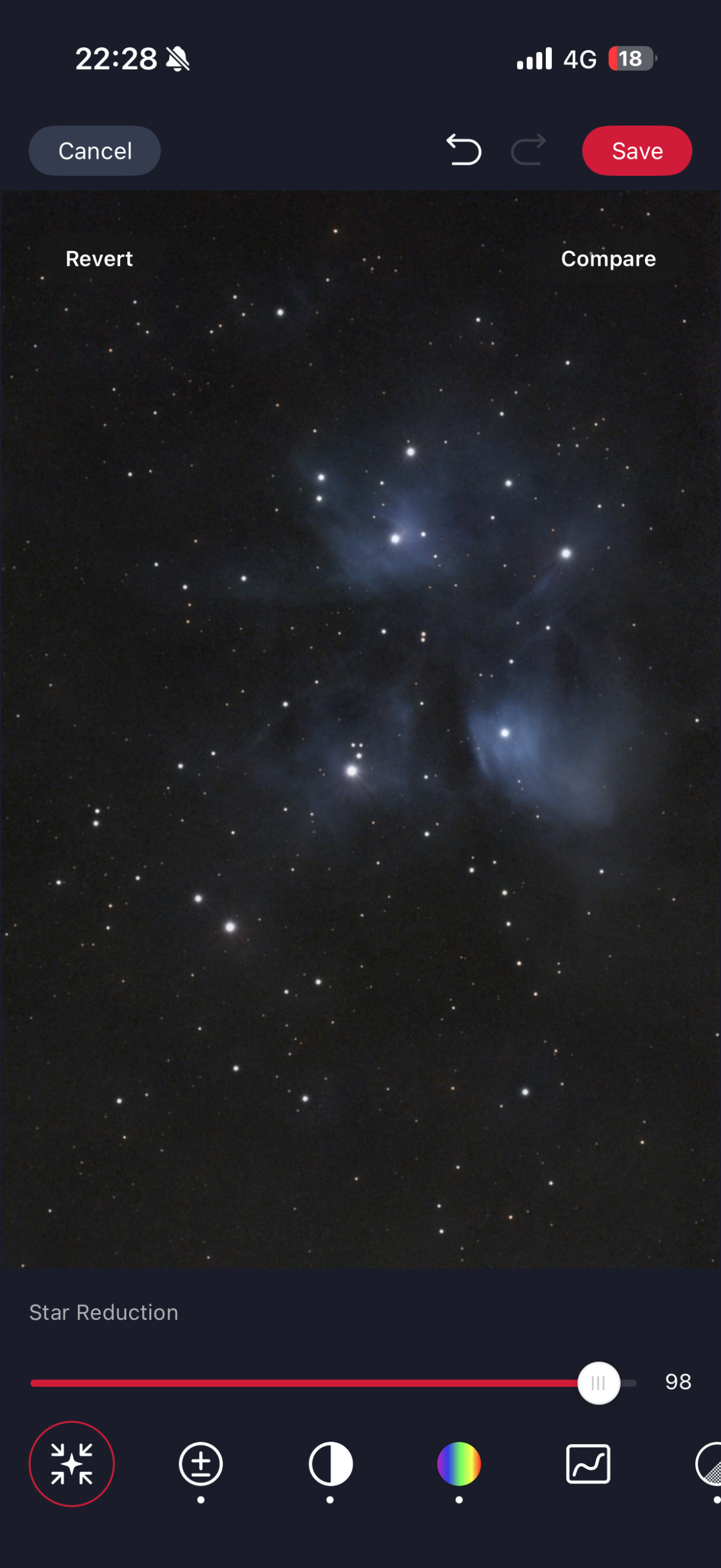 The star reduction slider in the Seestar app is a useful feature for seeing the faint nebulosity you've captured.App: ZWO Seestar, Image: Kimberley Lane/Future
Everyone's favorite star cluster, the Pleiades, was one of the first targets we wanted to capture. We could see the faint blue nebulosity after as little as 15 minutes of integration time, and it only improved over time. After 60 minutes, we had a really nice image and could easily bring out the blue haze via the editing tools in the app. However, we got a much more impressive result after tweaking our image a little further in Lightroom, bringing out even more haze and reflective dust.
Galaxies
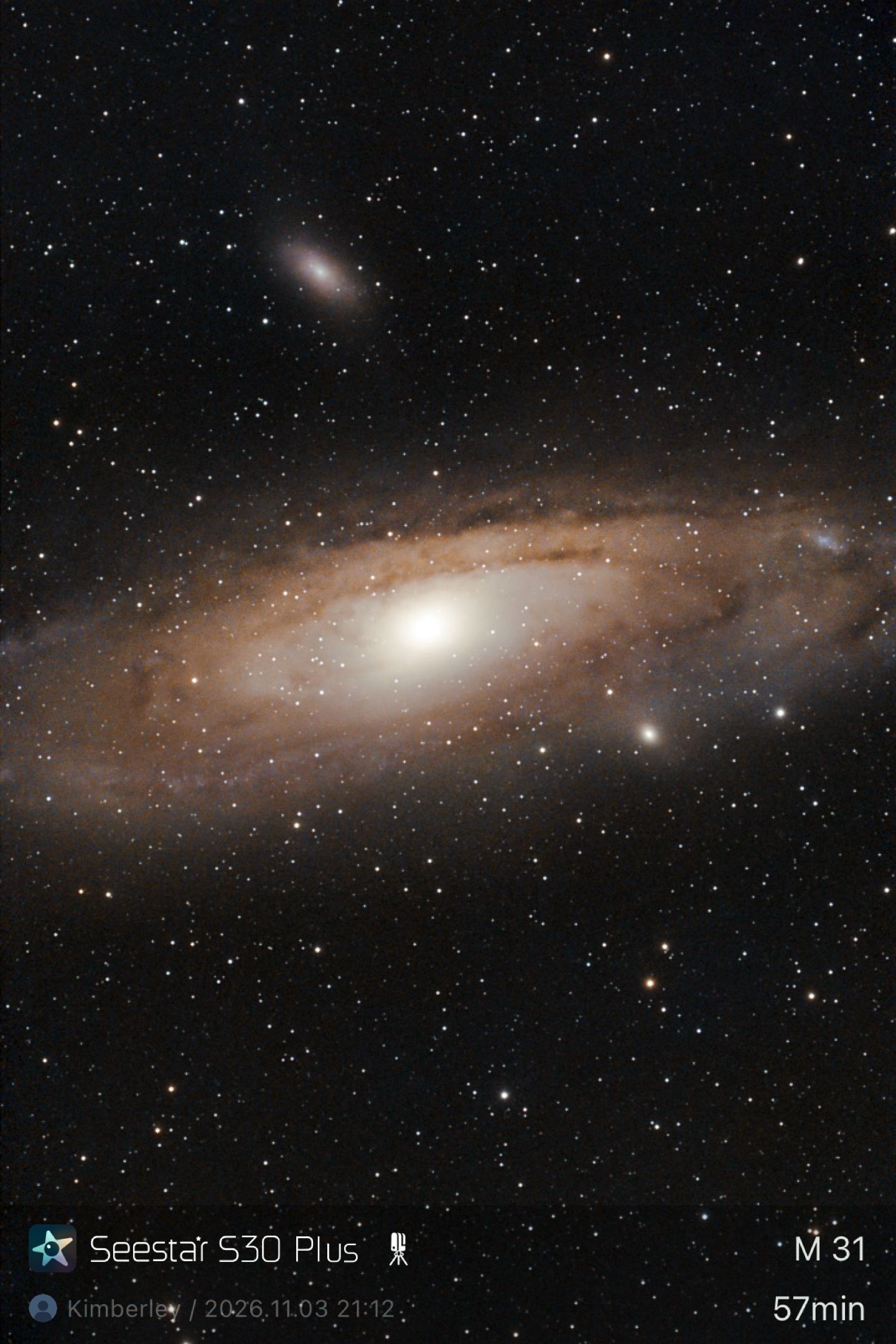 M31 after 57 minutes of integration, edited in the Seestar app and minor tweaks in Lightoom mobile.App: ZWO Seestar, Image: Kimberley Lane/Future
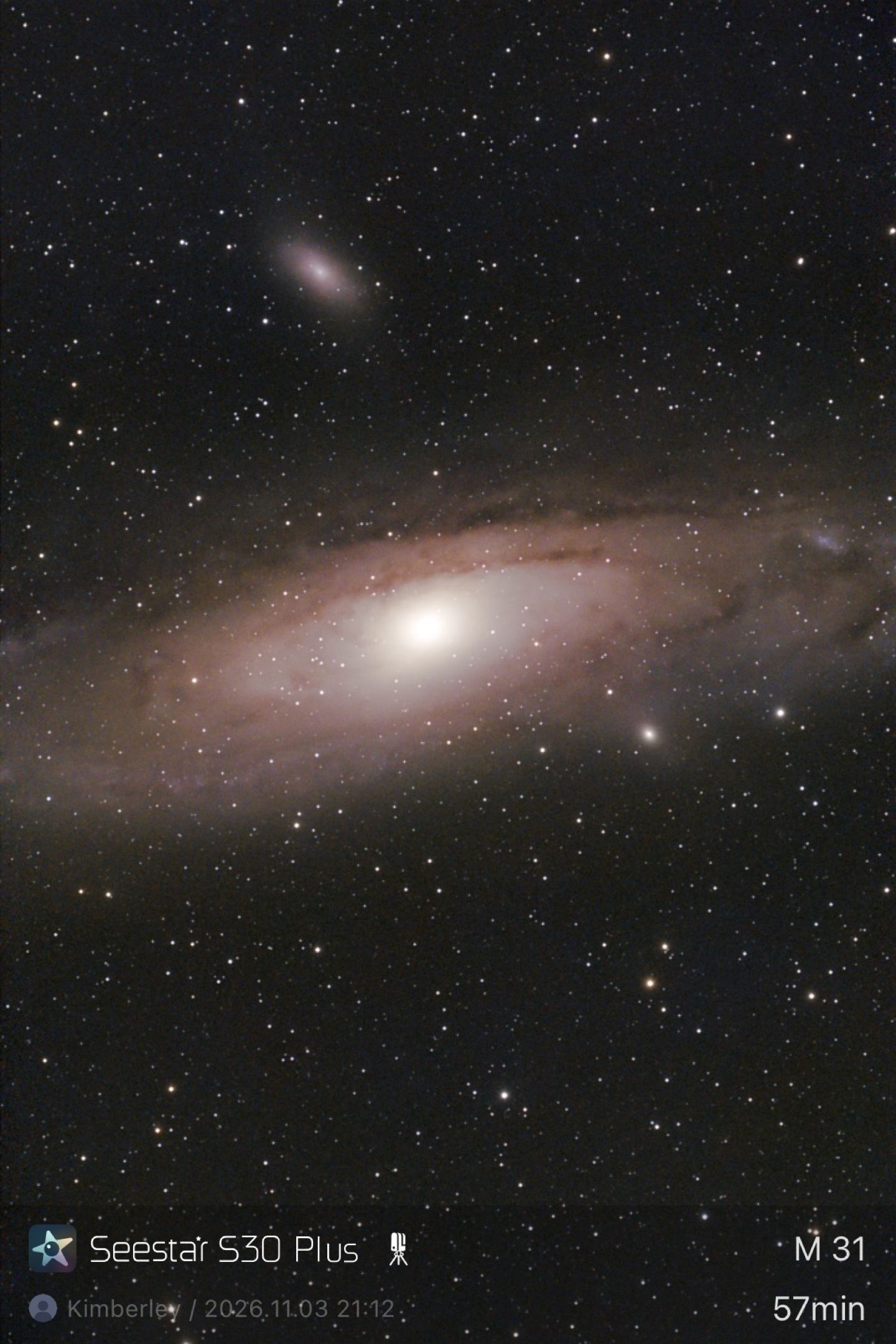 M31 after 57 minutes of integration, edited in the Seestar app.App: ZWO Seestar, Image: Kimberley Lane/Future
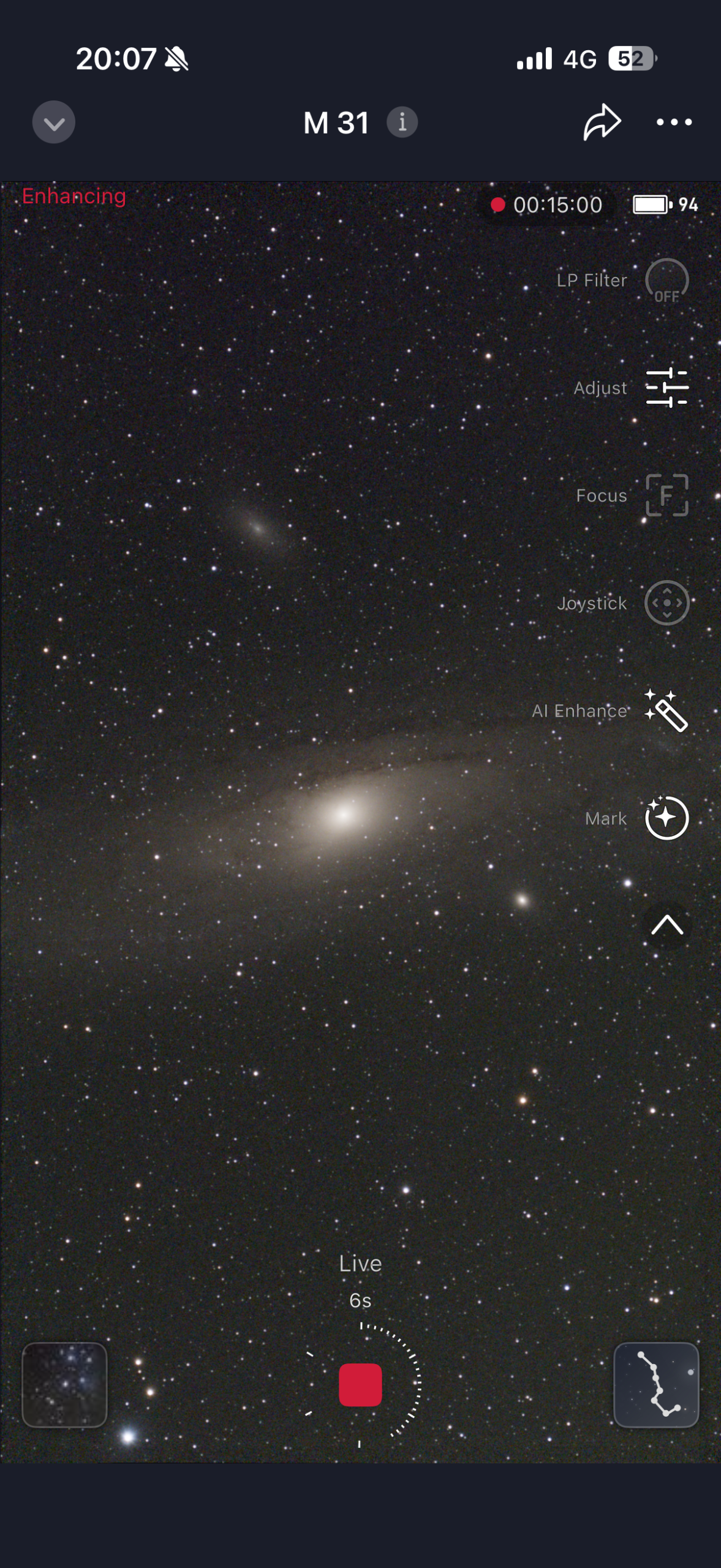 M31 after 15 minutes of integration.App: ZWO Seestar, Image: Kimberley Lane/Future
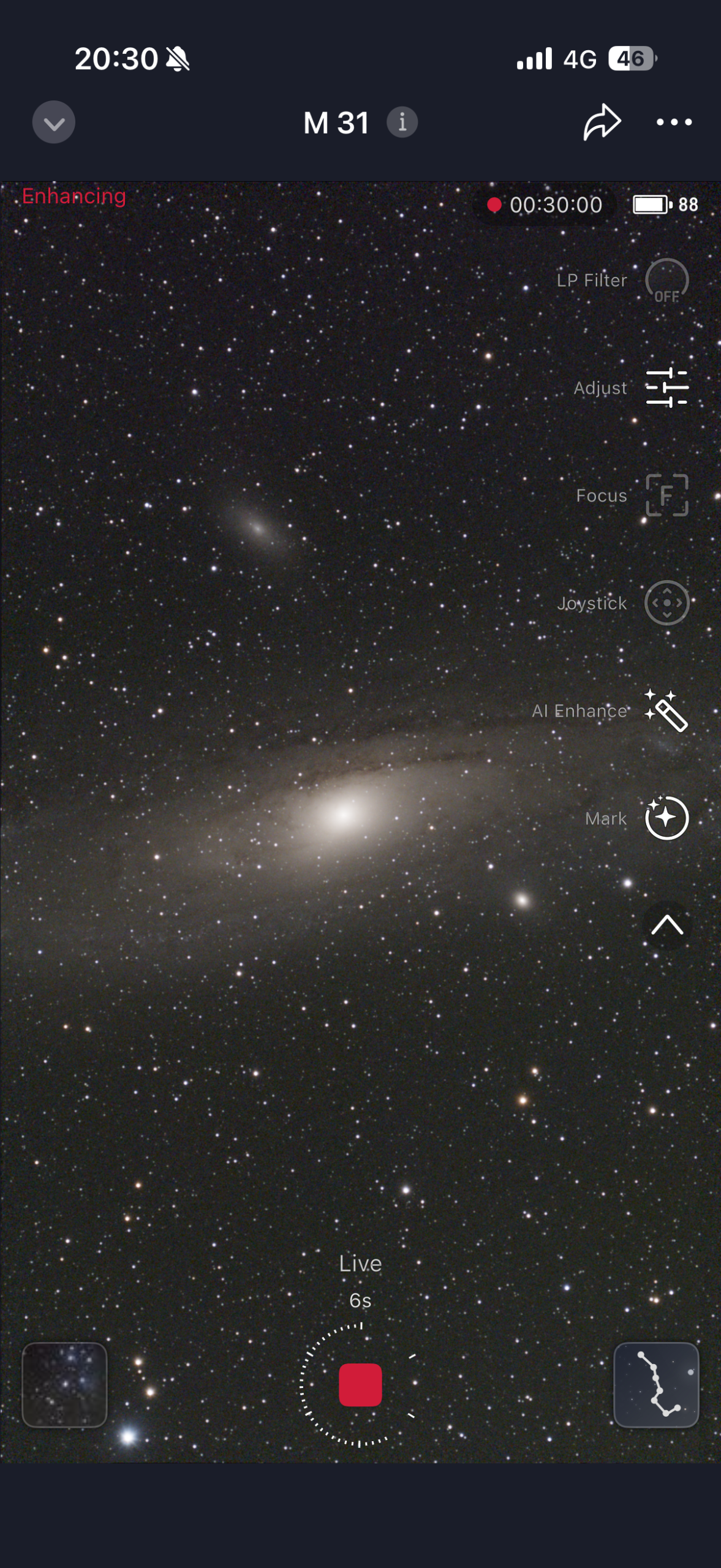 M31 after 30 minutes of integration.App: ZWO Seestar, Image: Kimberley Lane/Future
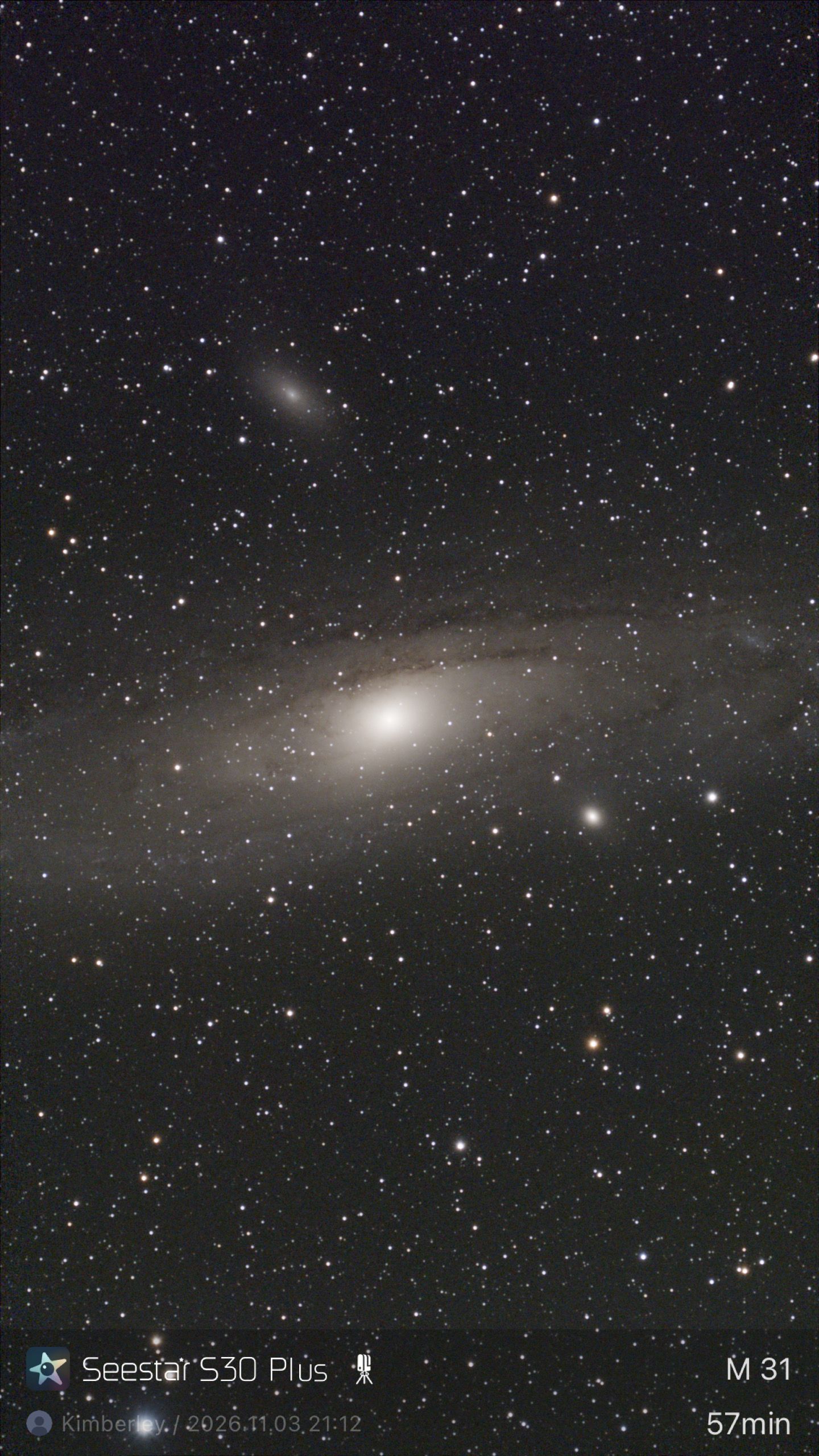 M31 after 57 minutes of integration, before any editing.App: ZWO Seestar, Image: Kimberley Lane/Future
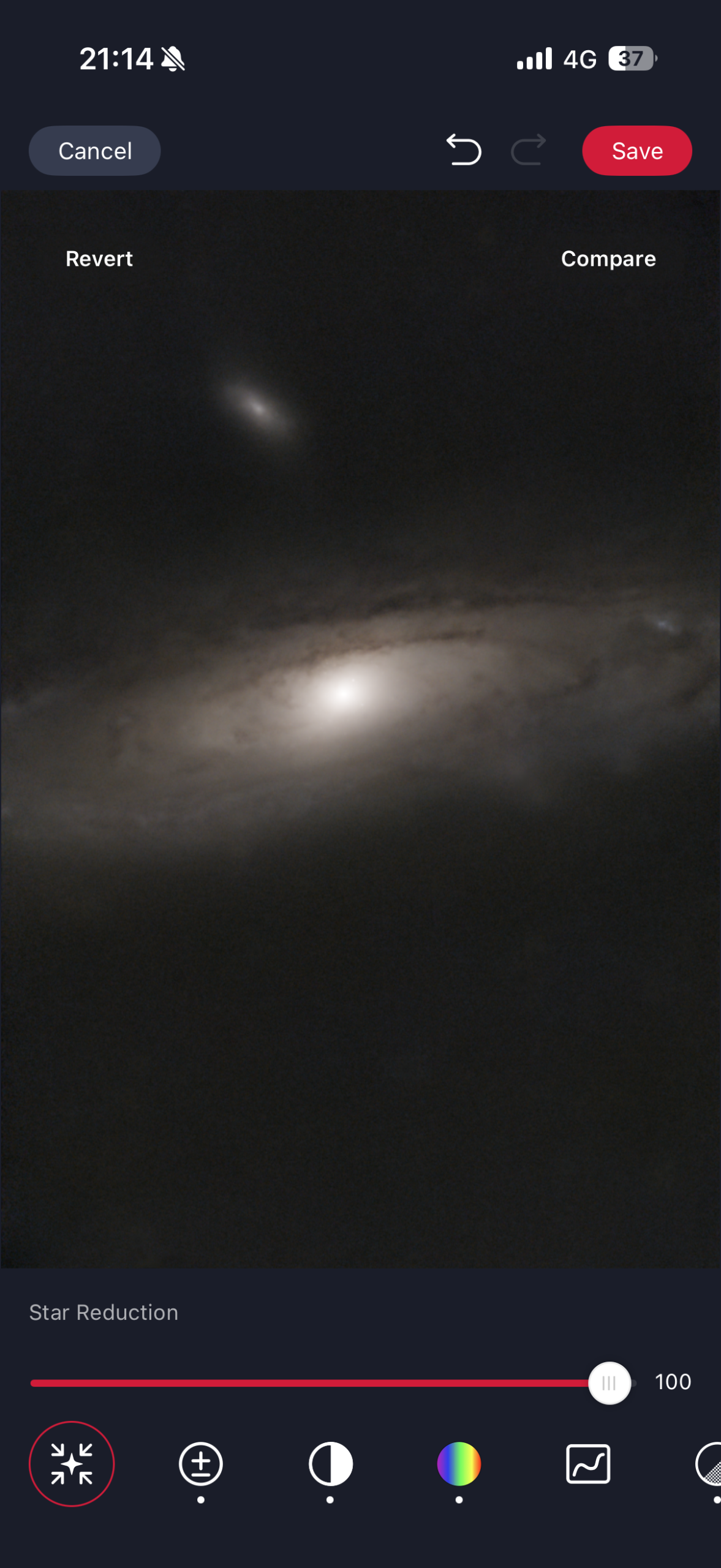 M31 with star reduction.App: ZWO Seestar, Image: Kimberley Lane/Future
The Andromeda Galaxy is a perfect target for the Seestar S30 Plus. It takes up a large portion of the frame, and with long integration times, it can reveal beautiful details in the faint outer arms. We shot for around an hour in our tests due to weather and time constraints, but we still got an impressive image. As we approached 60 minutes, there was a lot of cloud cover, and we noticed it struggling to stack images toward the end of the session, so we stopped the integration at 57 minutes.
Andromeda is certainly going to be the most impressive galaxy for the Seestar visually, as most others will appear smaller in the frame and will need longer integration, so make sure you have a clear, dark night for it.
Large emission nebula
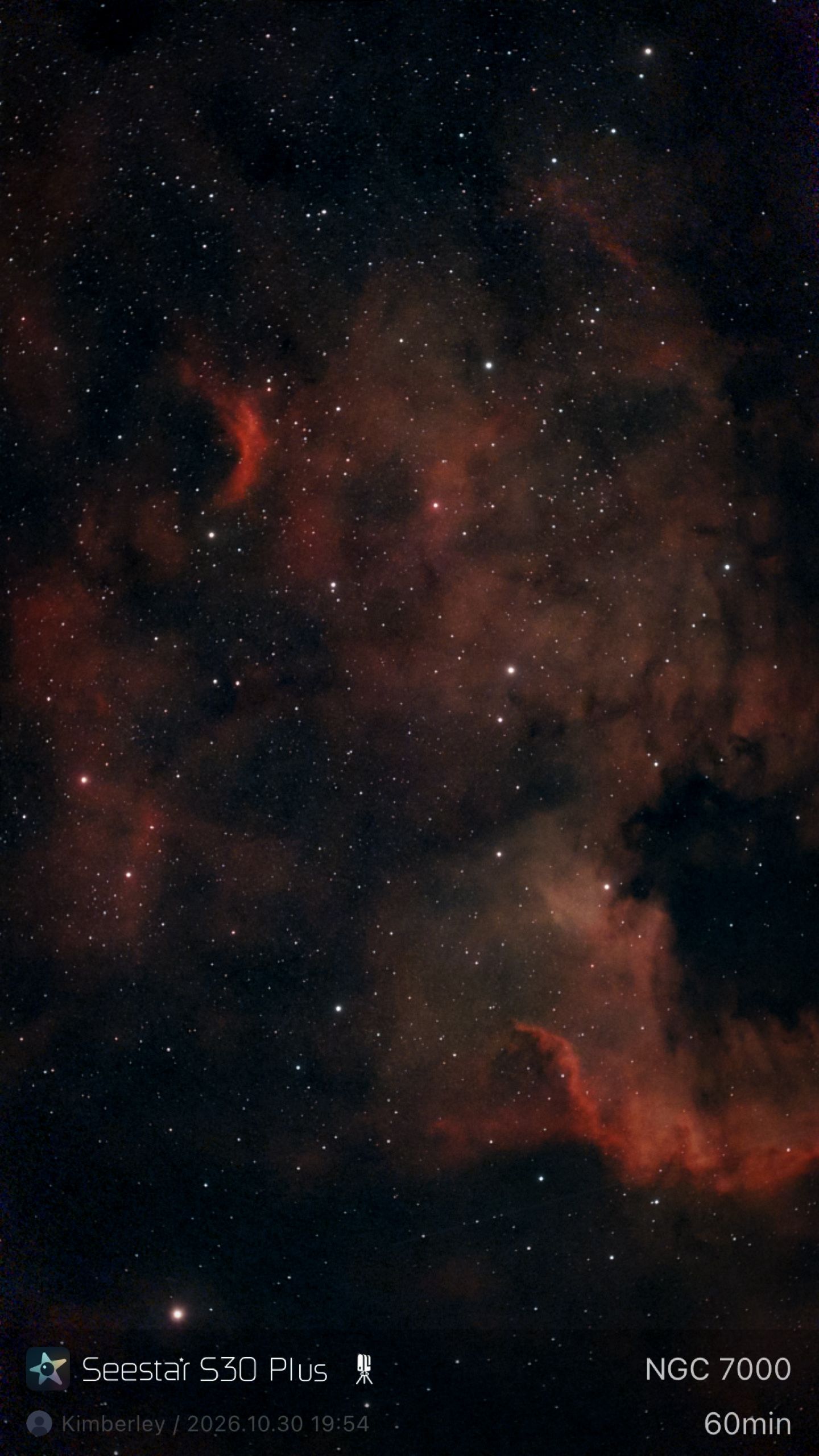 North America Nebula after 60 minutes of integration, edited in the Seestar app.App: ZWO Seestar, Image: Kimberley Lane/Future
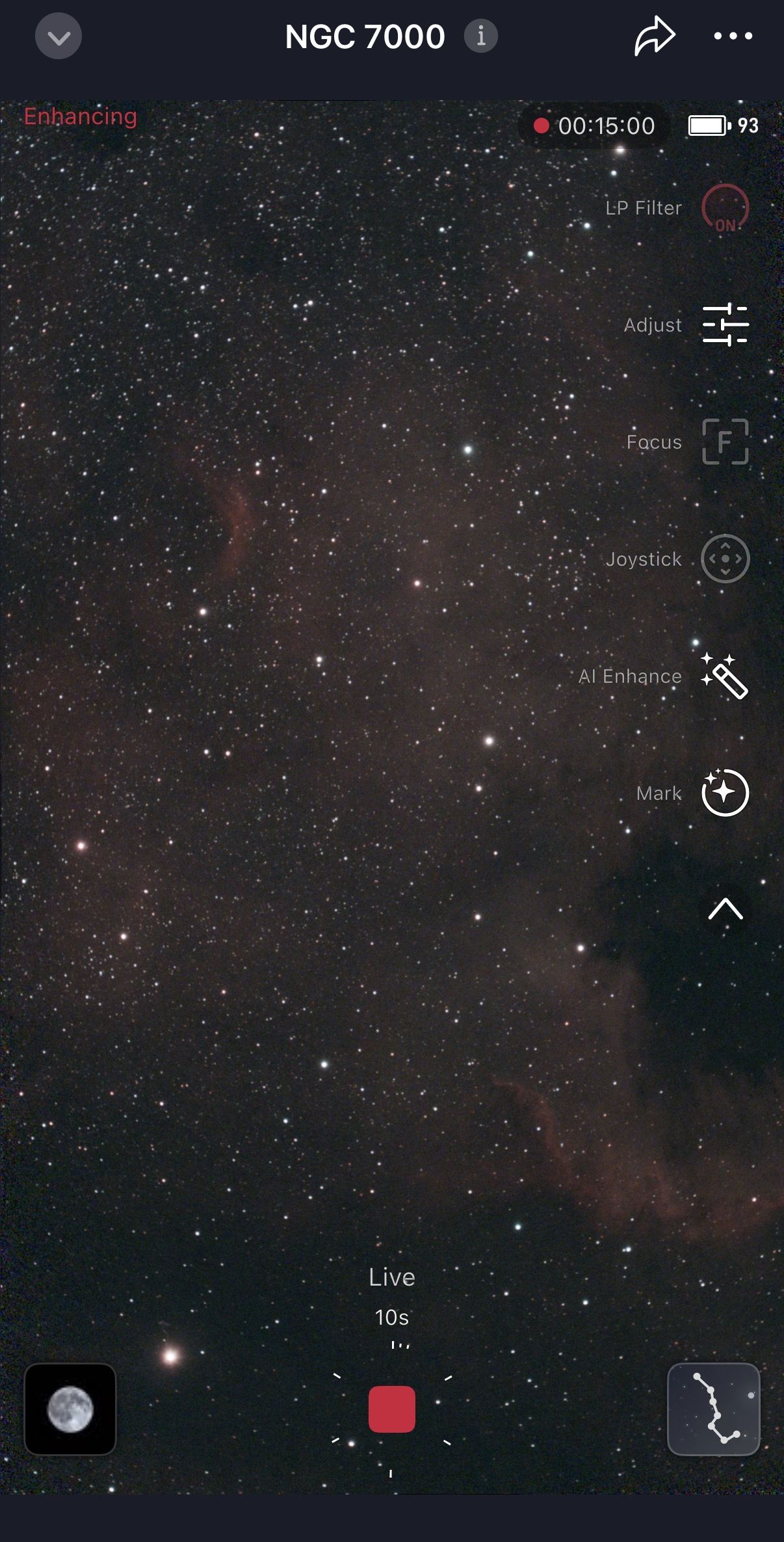 North America Nebula after 15 minutes of integrationApp: ZWO Seestar, Image: Kimberley Lane/Future
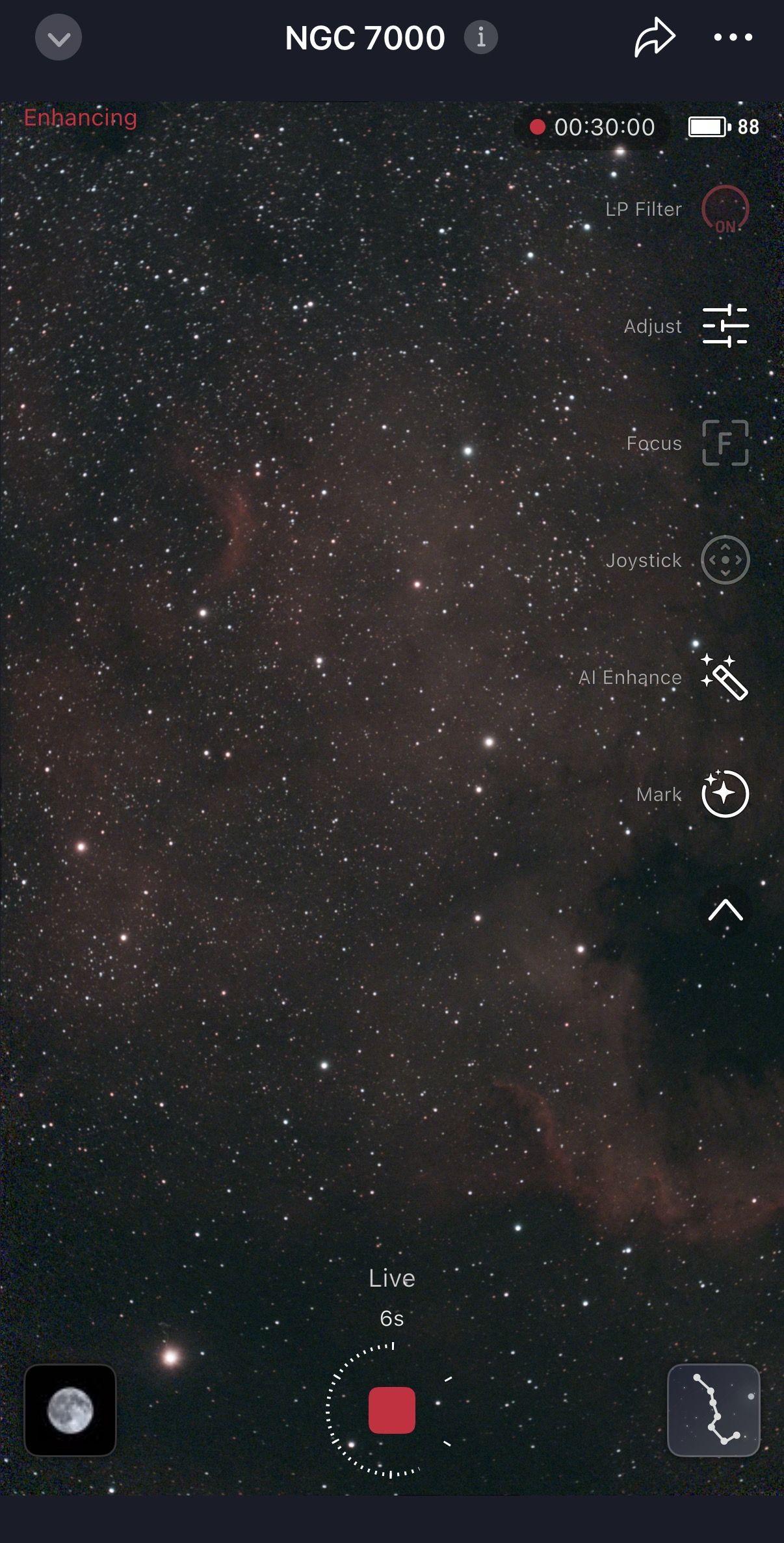 North America Nebula after 30 minutes of integrationApp: ZWO Seestar, Image: Kimberley Lane/Future
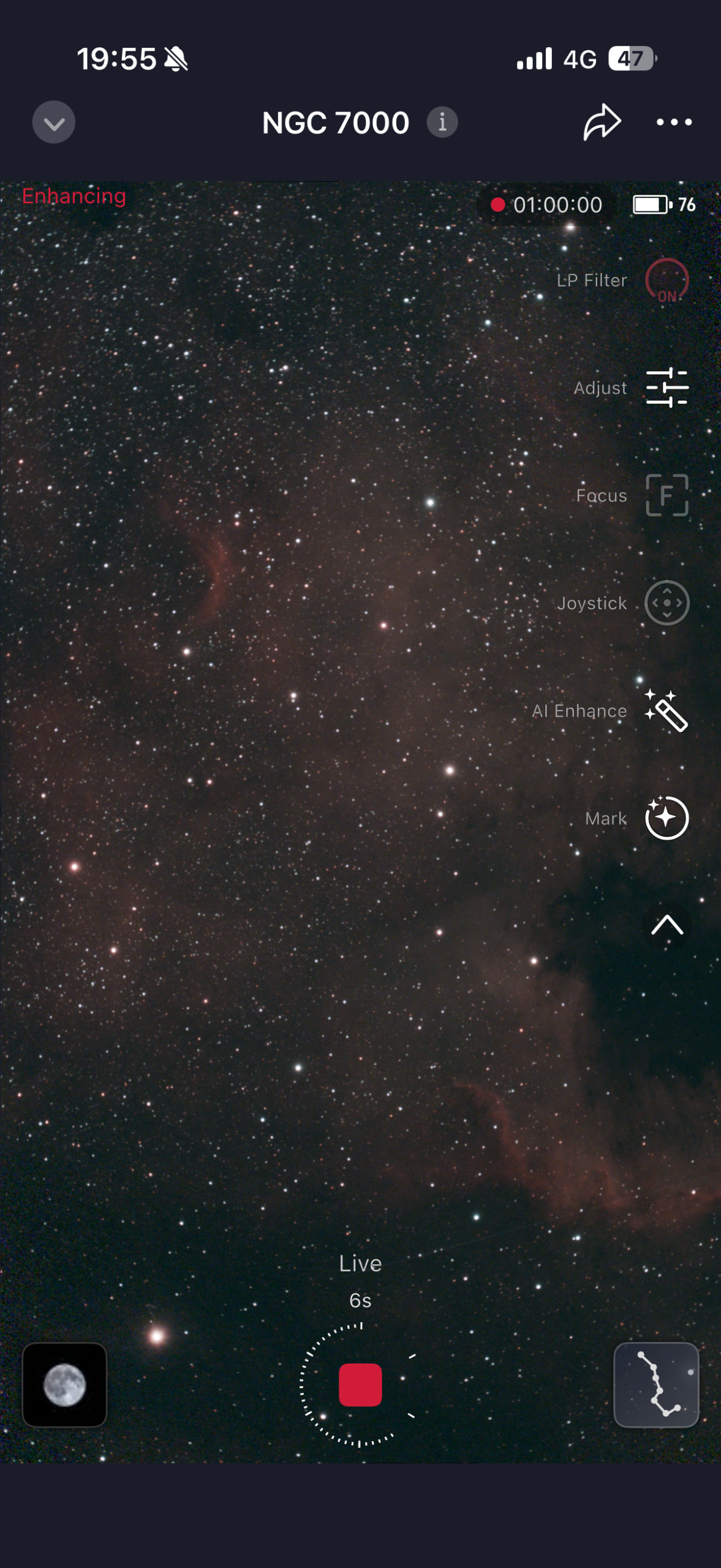 North America Nebula after 60 minutes of integration, before any editing.App: ZWO Seestar, Image: Kimberley Lane/Future
Large emission nebulas are where the Seestar S30 Plus thrives, and the North America Nebula is a great target. It covers the whole field of view, and the red hydrogen gas easily comes to the forefront of the image.
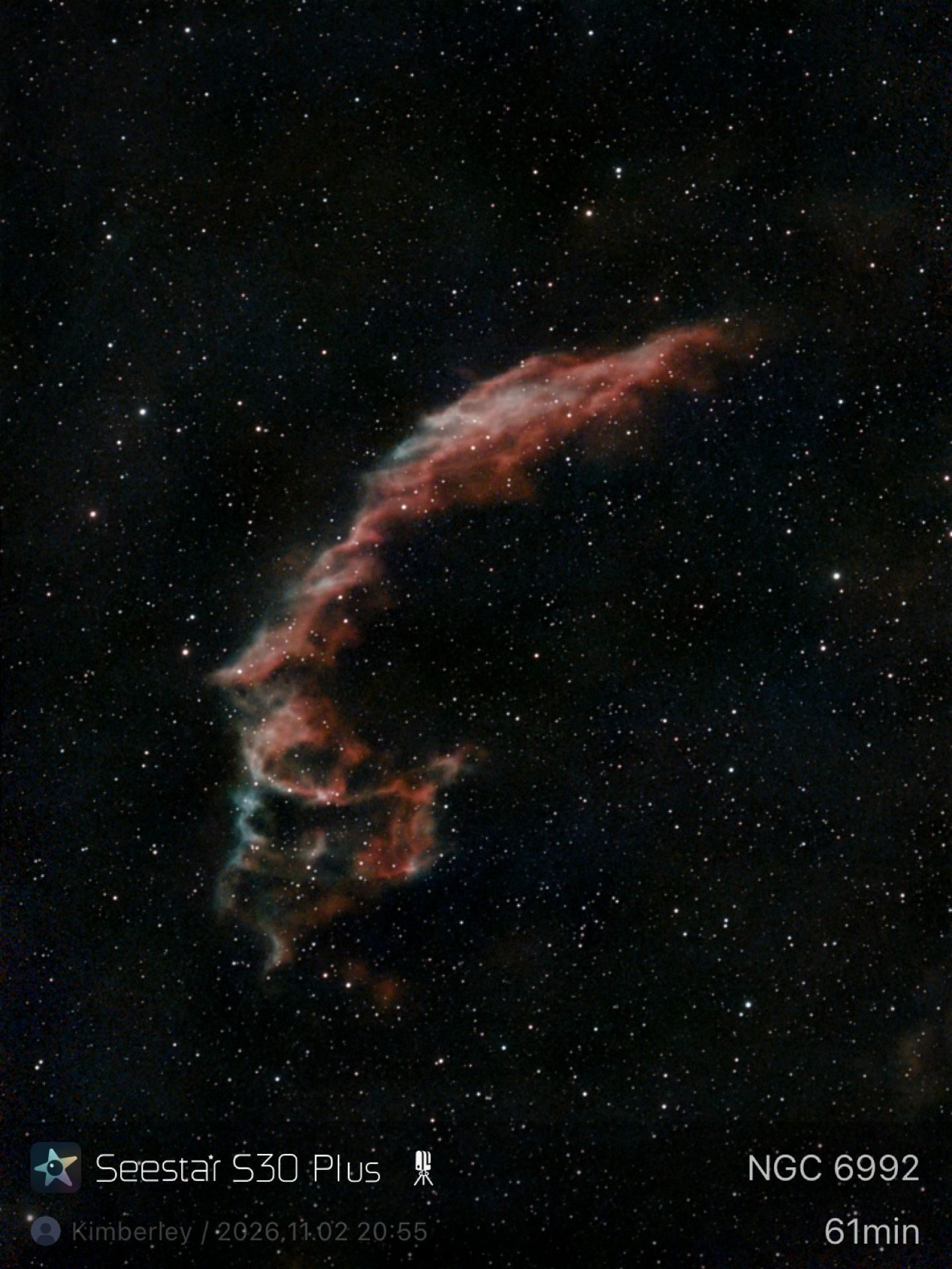 The Eastern Veil Nebula after 61 minutes of integration, after editing in the Seestar app.App: ZWO Seestar, Image: Kimberley Lane/Future
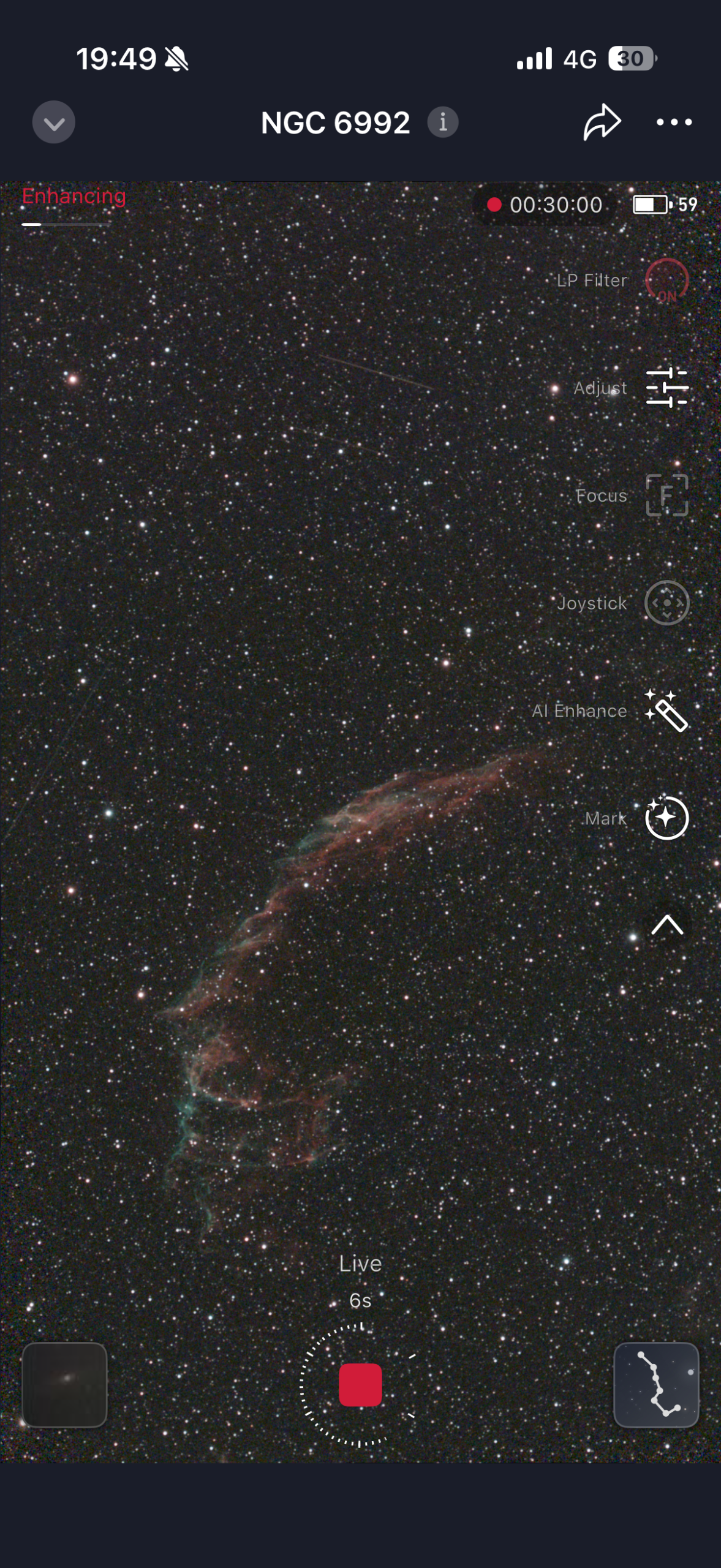 The Eastern Veil Nebula after 15 minutes of integration.App: ZWO Seestar, Image: Kimberley Lane/Future
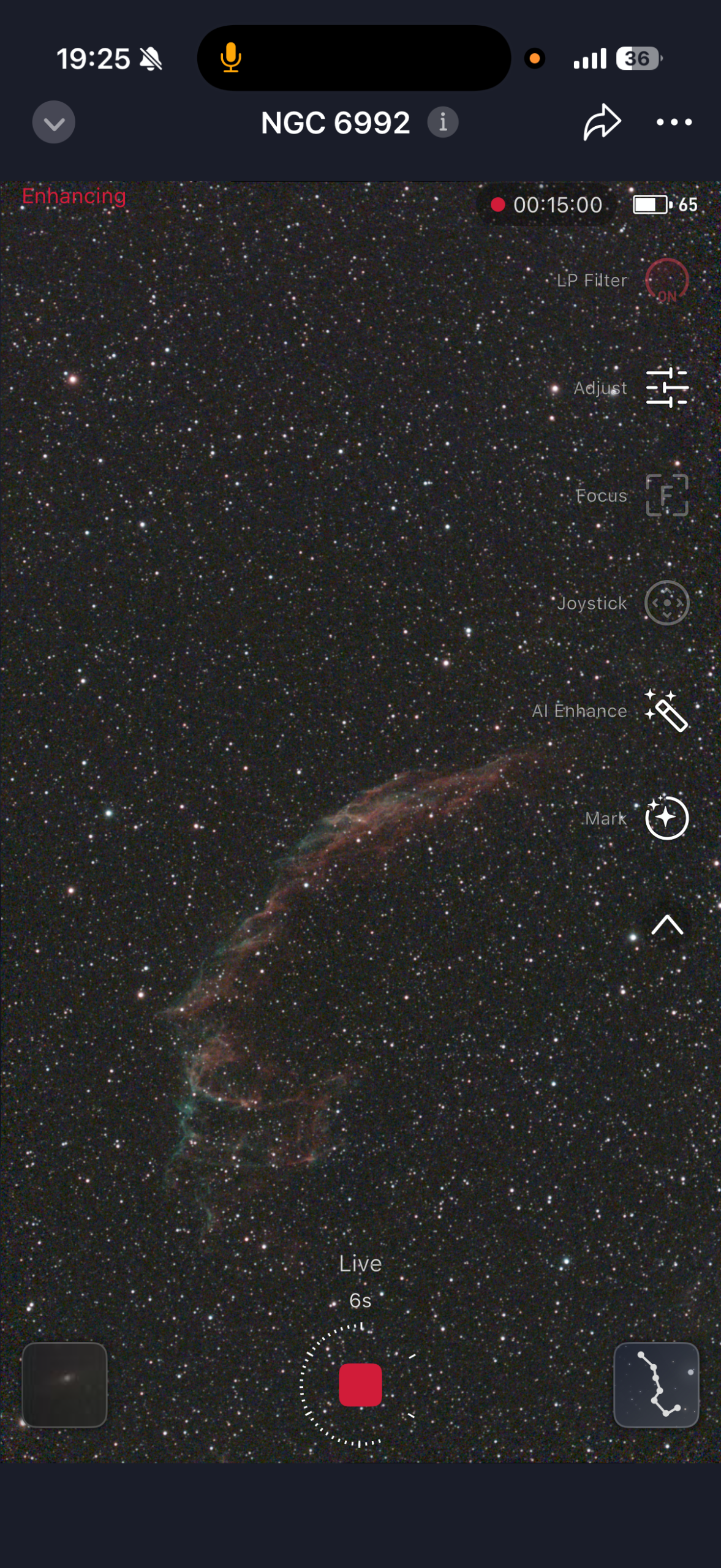 The Eastern Veil Nebula after 30 minutes of integration.App: ZWO Seestar, Image: Kimberley Lane/Future
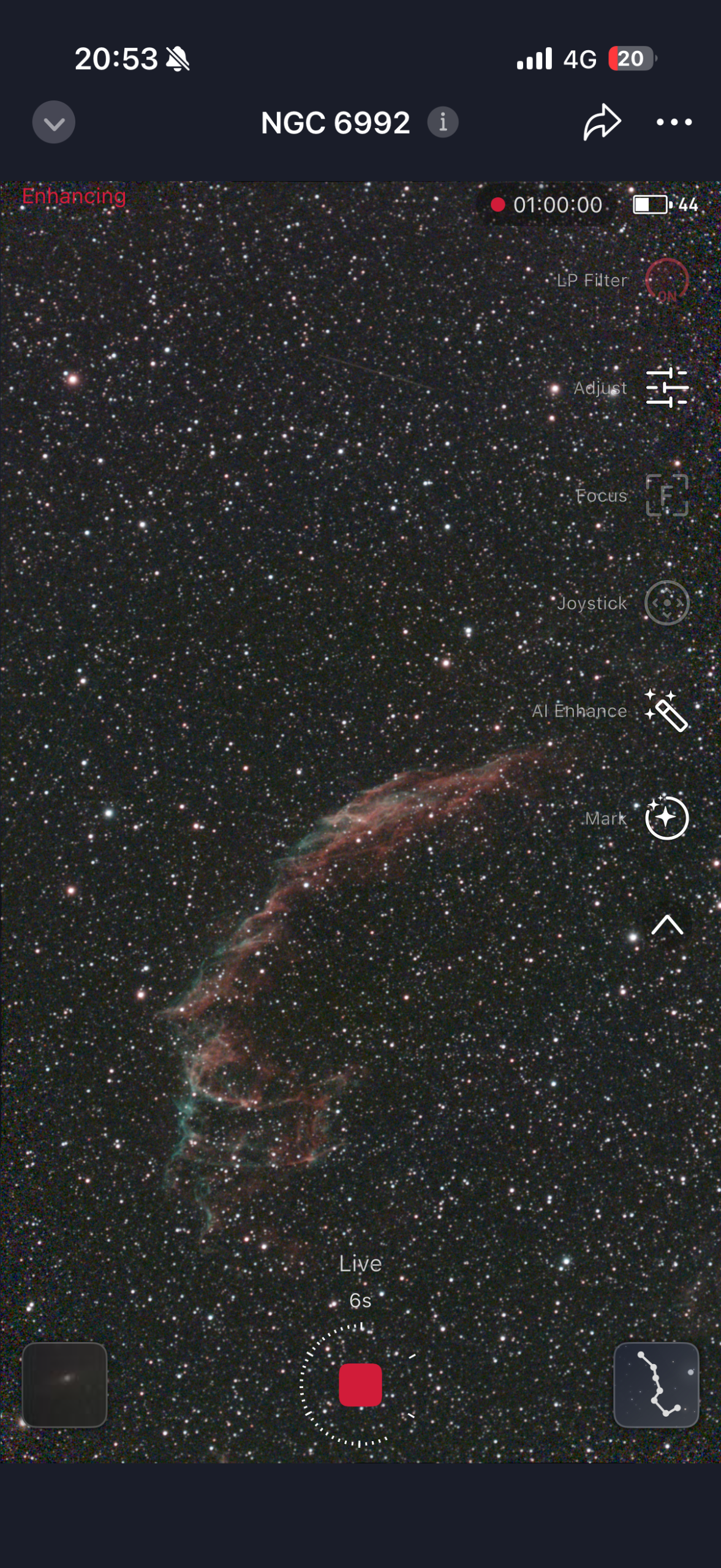 The Eastern Veil Nebula after 60 minutes of integration, before editing.App: ZWO Seestar, Image: Kimberley Lane/Future
The Eastern Veil Nebula is another lovely target where you can bring out the beautiful red and turquoise hues in as little as 15 minutes, but longer integration times will yield brighter, more colorful results.
Planetary nebula
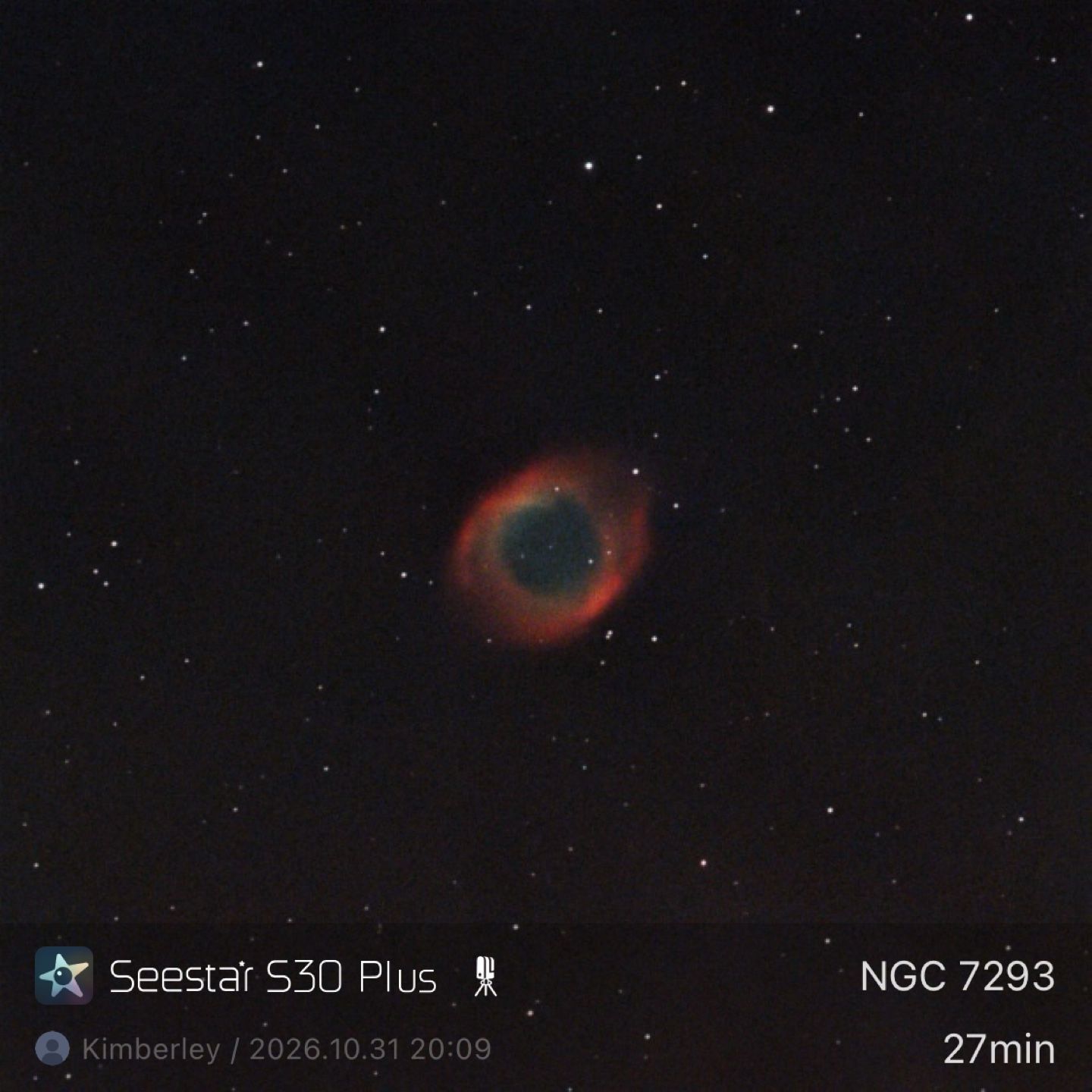 Helix Nebula after 27 minutes of integration, edited in the Seestar app.App: ZWO Seestar, Image: Kimberley Lane/Future
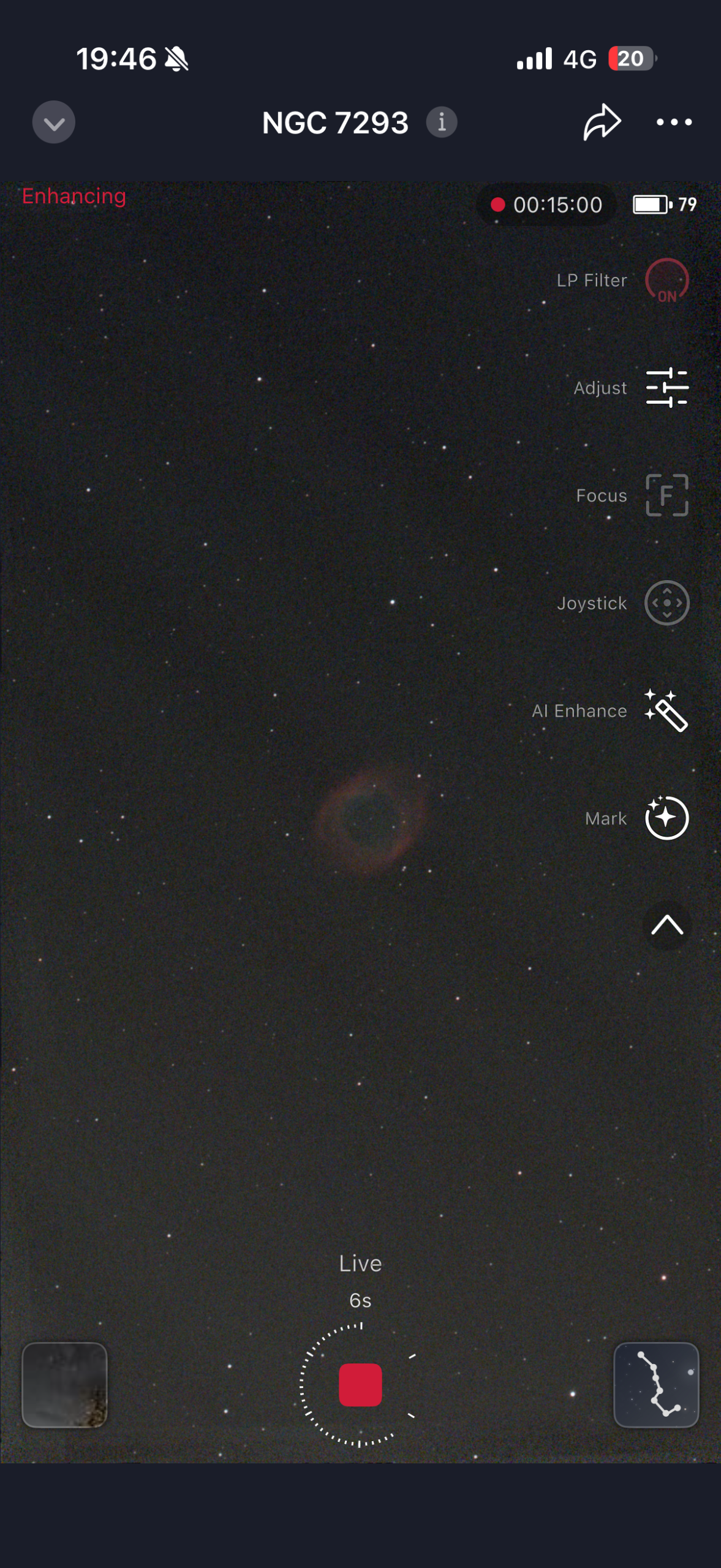 Helix Nebula after 15 minutes of integration.App: ZWO Seestar, Image: Kimberley Lane/Future
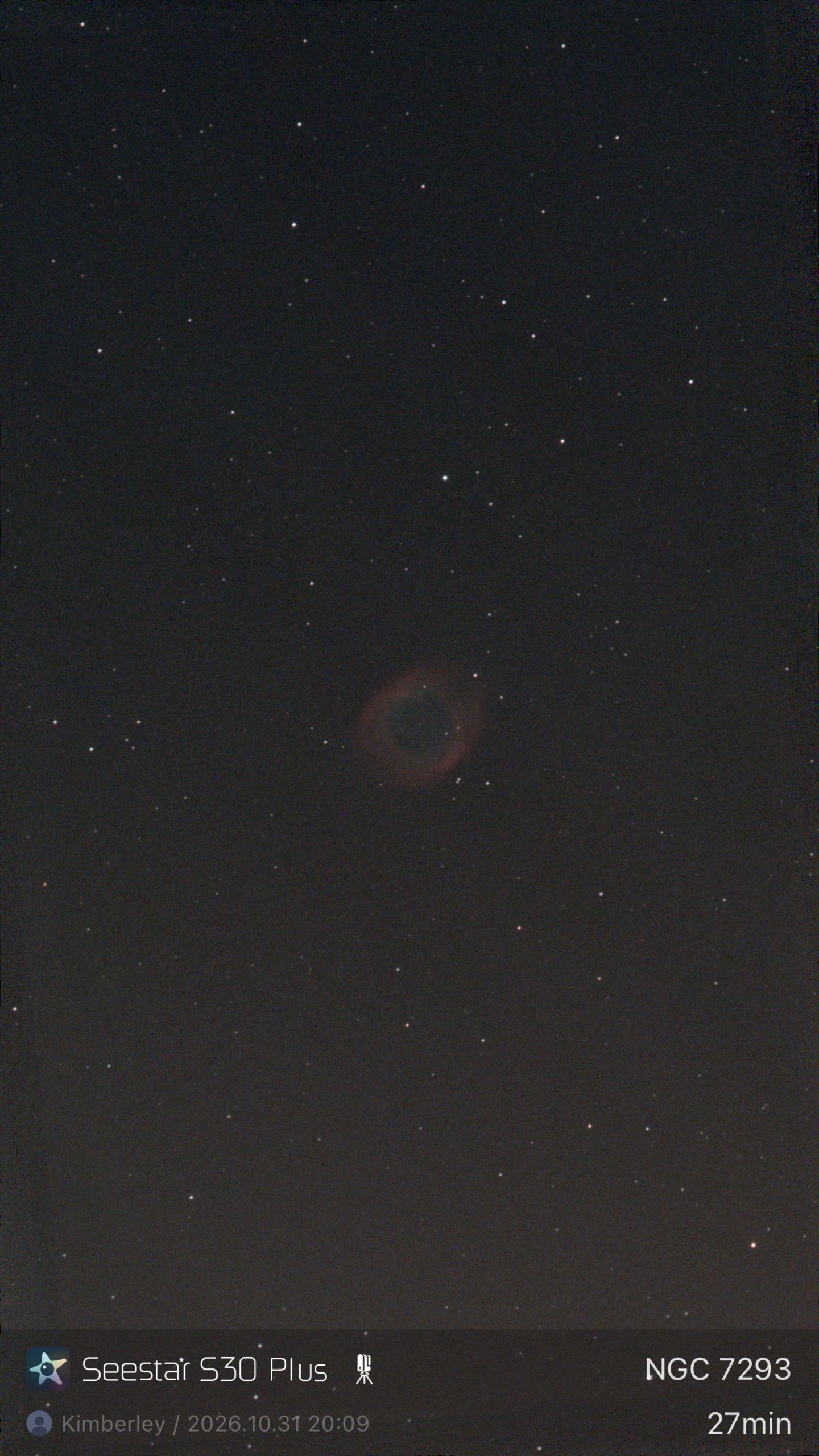 Helix Nebula after 27 minutes of integration, before editing.App: ZWO Seestar, Image: Kimberley Lane/Future
Planetary nebulas are where you will see the limitations of the Seestar's 160mm focal length. Most planetary nebulas have a very small apparent size — we've previously captured the Dumbbell Nebula and Cocoon Nebula with our S30 Pro, and they were a tiny dot in the middle of the screen. We tried the Helix Nebula, and even though it's one of the largest apparent planetary nebulas, it's still fairly small on the Seestar S30 Plus. You can still get a decent image of it, but if you want to focus on imaging planetary nebulas, you'll need a bigger scope. Because it was very low in the sky and there was some interfering cloud, we stopped integration at 27 minutes.
Should you buy the Seestar S30 Plus?
 Kimberley Lane
 Kimberley Lane
The Seestar S30 Plus is an affordable entry point into deep-sky astrophotography without the confusing settings and expensive setup. It's ideal for beginners, although more experienced users will likely want to upgrade to the superior image quality and extra features of the S30 Pro.
Still, for under $500, we can't complain. Not only is the Seestar S30 Plus easy to navigate and use, but it teaches you about space in a fun and interactive way, and you don't need to spend hours stacking individual frames on your computer to process — although you still can do that if you want more control over your editing.
If the Seestar S30 Plus isn't for you
 If you want better image quality
If you can stretch your budget, the S30 Pro is a worthy upgrade. It produces 4K images and offers more pro-level features.
Read our full Seestar S30 Pro review
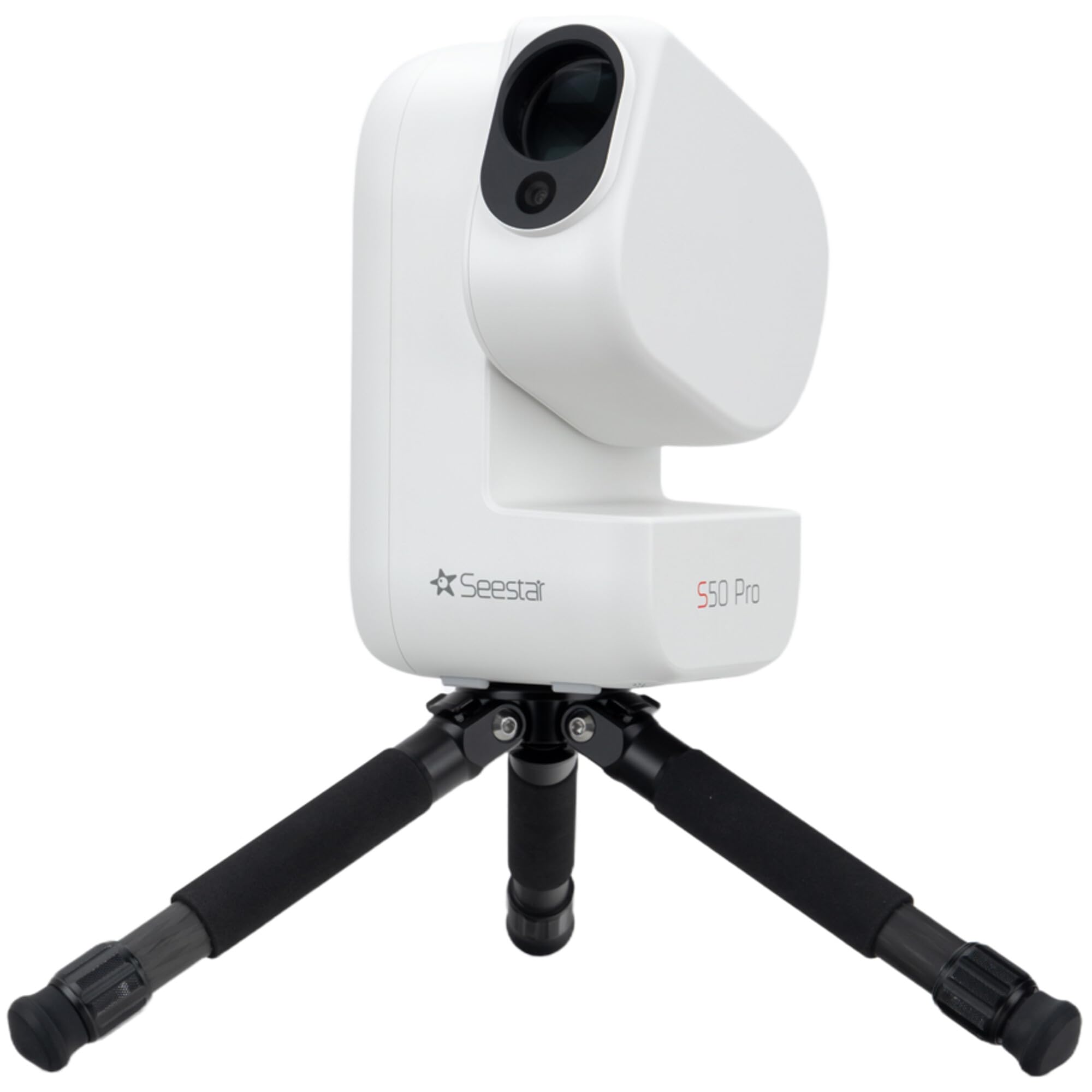 If you want a longer focal length
To see deeper into space, the Seestar S50 Pro has a longer focal length of 260mm and a larger 50mm aperture, making it better for smaller apparent objects.
Read our full Seestar S50 Pro review
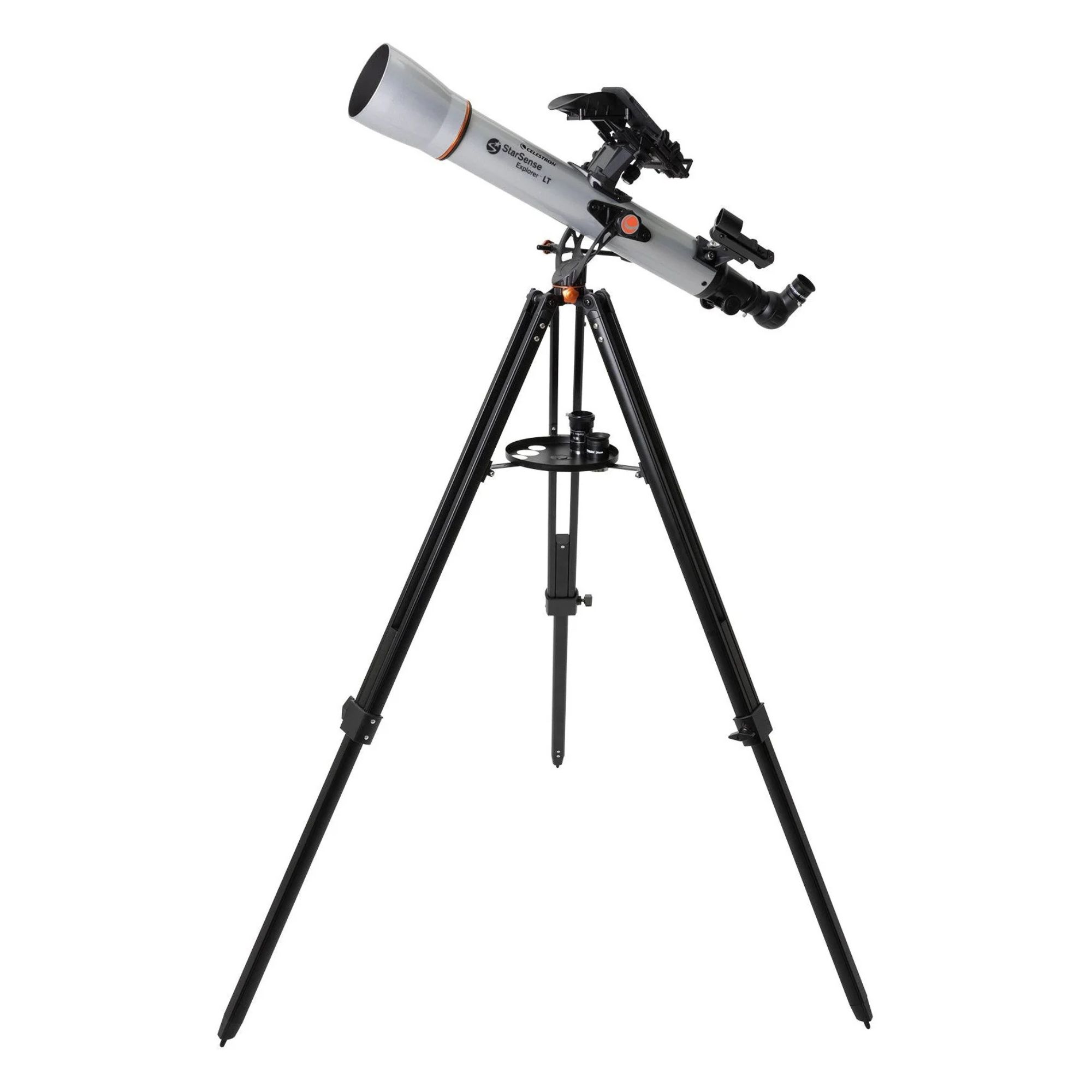 If you want a more traditional telescope
Celestron StarSense Explorer LT 70AZ
If the imaging aspect doesn't interest you, the Celestron StarSense Explorer range of telescopes connects to your phone to guide you around the sky, but you observe the cosmos through an eyepiece instead of capturing it on your phone.
Read our full Celestron StarSense Explorer LT 70AZ review
'> ZWO Seestar S30 Plus review I wanted to do a Ph.D. on animal behavior and, more specifically, on relationships between animals. I was interested in how animals interact with each other and what kind of social organization they establish.
[Someone suggested I] work on the zebra finch, and I said, "OK, I've never taken the time to really observe birds very well; might as well start now."
I realized that it's difficult to observe birds because they're not close to you. They can fly wherever they want. When you are out and about in town, in the countryside, and you see birds, they're here, and then they're gone. You don't get to see a lot of their vocal interactions or a lot of their social interactions.
So here I was, studying the zebra finch in cages where they were fully interacting with each other. And the question was, what kind of social organization do they have?
I realized quickly that they were not doing a dominance hierarchy [which was previously thought to be the case], but instead, the most important thing in their life was their partner. They were doing pair bonds, and that's the core of their social organization, [with] males and females pairing for life.
Studying birdsong can help researchers like Elie better understand how the birds navigate their complex environments. (Image credit: Nataly Studio/Shutterstock)KHC: Why is it important to study birdsong, and what can it teach us about intelligence and behavior?
JE: A level of complexity we were trying to understand was, what are the neural mechanisms that enable those birds to do this process of listening to something and copying it, and reproducing it, and doing a comparison between what they're producing and what they're hearing?
The zebra finch is a just-right middle ground level of cognitive ability that is interesting, where you see this pattern of copying vocalization and producing it. But you can look through the avian kingdom, and some species show more complex behaviors.
We know that there are some species that are able to not only imitate their own vocalizations from their own species, their dad, but they're able to copy other species. So, here in California, for instance, a mockingbird is a bird that is really known to be able to reproduce a bunch of different sounds and is actually incorporating this in their vocalizations.
Parrots are also well known for that because we have them as pets, and they're able to reproduce our own vocalizations as humans. This is kind of crazy, when you think about it, because they don't have the same vocal tract as we do. It's smaller, and they have a different system. I think a high cognitive level is when an animal is able to reproduce a sound that is not in their "native language," let's say, and use it for a goal. We do see this in parrots — they're able to ask you for something or even ask the dog to shut up sometimes, which is interesting. They're able to really use those vocalizations, such as "This is not mine, but I communicate with another species this way."
It shows you how smart they can be, and by studying vocal communication in animals, we are getting a window of what cognitive abilities they have and how the usage reveals their level of smartness.
KHC: Could you walk me through how you ended up decoding bird vocalizations?
JE: I spent countless hours observing zebra finches, and I realized that I could progressively do a match between the social context and the acoustic characteristics of the sound produced. I could recognize these sounds and understand what they "mean."
It's like at home with your cat or dog: Within a couple of months, you figure out every time the cat is doing this kind of sound — "meow" — it means he wants to get out or he's hungry, or he wants to cuddle. Same thing with the dog. It's the same process, but instead of doing this with cats or dogs, I did this with birds and constituted the first acoustic dictionary of zebra finch calls.
However, how do you know you are correct? That you correctly identified the sounds that correspond to the "words" in that species?
Pet owners can often differentiate between different vocalizations in their pets, such as different meowing noises for their cat. (Image credit: Chris Winsor via Getty Images)I thought that the best confirmation of whether I was right or not could only come from the zebra finches themselves. Up to now, nobody had found a way to systematically go through the vocal repertoire of an animal and confirm if each identified call type was indeed perceived as a word in that species' language.
To achieve this somewhat impossible discussion with a bird, we designed an operant conditioning experiment where the bird is asked to classify vocalizations that were previously recorded from other zebra finches. The game is simple and relies on two rules. The first one is that every day, only the recordings corresponding to one call type are rewarded by seeds, while the recordings from the other call types in the repertoire are not rewarded. The second rule is that the bird can interrupt recordings and skip to the next one whenever they want, like how you skip through songs on your favorite music app.
The bird is placed in a cage that has a button or a little infrared sensor that it can activate with its beak. Each time it does so, the recording of a vocalization randomly drawn from the library of call types is played. Four out of five times, birds trigger the playback of a call type that will not give them access to seeds. Because they are slightly food deprived, they only really want to listen to the rewarded playback, so they interrupt the nonrewarded calls and only listen for the calls that are going to be rewarded.
Every day, the bird has to find out which call type or "word" is rewarded. They usually figure it out pretty rapidly and then start interrupting the playback of all the other call types. Using this task, we could test a different call type every dayIf they had not been able to do it, it would tell us that the call type we had identified was in fact not existing in their language. If they were able to do it — and spoiler alert, they were! — it meant that we had correctly identified that call type.
The birds told us yes, basically — the organization that you're proposing is correct.
But then we made a surprising discovery. We noticed that birds were making some rare and systematic mistakes. We wondered if these mistakes were coming from the acoustic similarity of the call types — how you might mistake, for instance, the word "glove" for "love" or "hurt" for "heart." Or if they were coming from the semantic similarity of the call types — you could maybe mistake "love" for "heart" if you are remembering about the general meaning of the rewarded word today, which is "love.".
In that last case, it would mean that birds truly have an understanding of their call types' meaning. We found out that birds' errors could be better explained by the meaning [the semantic similarity] of the call types. That is a big discovery in the field of animal communication.
I'm thinking that the first species we might be able to communicate with, interact with vocally, might be a bird.
Julie Elie
KHC: Do you think we are headed toward actually being able to communicate with birds, or do you think it's more that we're still testing the waters and we still need to learn the rest of the language before we get there?
JE: When we say "talking with birds," I think we need to understand that it's not going to be a language. Right now, I am studying the zebra finch; it doesn't mean that I would be able to communicate with a crow once I have a repertoire. So there's this component of when we talk about birds, there are many different species.
I think there's more traction in this particular part of the animal kingdom than in other parts, just because birds are really talkative. Birds use a lot of their vocalizations to communicate with each other. So because of that, I'm thinking that the first species we might be able to communicate with, interact with vocally, might be a bird, just because they are very talkative.
For now, I found all those words. But we need to understand how those words are [strung] together. So it's not necessarily the case that we need to understand the rules of the dynamic exchanges between individuals or how fast you're responding, but how you are responding and whether that makes sense or not.
They [also] have [body] postures. They have specific displays at the same time they're producing the vocalizations. And if we really want to achieve full communication with another species, we need to get to that level.
It's not tomorrow for sure, it's probably not next year, but I think in the range of 10 years we should get there. Especially with how fast the domains of AI and robotics are. I have some hope that we should be able to get to that point.
Exclusive to Live Science Pro
KHC: Is there one takeaway you would want our readers to know about your work?
JE: Just one. The most important thing for readers that are not specifically scientists is to realize that, by studying animal behavior more generally, researchers are discovering the intelligence of animals. This is opening our eyes to other species and realizing that we're not the only species that is intelligent on this planet.
This is a lesson to us as another species on this planet, that we are not the only ones that are smart and we need to take this into account in how we are evolving.
We need to realize how we're affecting them and realize that they also have their own internal lives, and maybe we should start to respect them a little bit more.
Editor's note: Some of this interview was conducted via email as part of a follow-up conversation. The interview has been edited lightly for clarity and length.
Help us improve Live Science Pro: We're always trying to make our content better. Leave us feedback about Pro here.
'> 'The first species we might be able to communicate with, interact with vocally, might be a bird': An animal researcher explains how she decoded bi...