Excluded Journals From SIS
|
ID
|
Journal Title
|
E-ISSN
|
Excluded
Date
|
|
|
|
|
|
|
204
|
International Journal of Advanced in Biological Sciences
|
2348-8069
|
June. 2015
|
|
804
|
Journal Of Agricultural Science And
Applications
|
2227-6483
|
June.2015
|
|
805
|
Journal Of Control Engineering And
Technology
|
2225-6598
|
June.2015
|
|
837
|
Journal Of Electrical And Control
Engineering
|
2226-289X
|
June.2015
|
|
838
|
Journal Of Life Medicine
|
2329-5449
|
June.2015
|
|
839
|
International Journal Of Mechanic
Systems Engineering
|
2226-6461
|
June.2015
|
|
840
|
Thermal Energy And Power Engineering
|
2326-053X
|
June.2015
|
|
841
|
Current Advances In Energy Research
|
2374-5509
|
June.2015
|
|
842
|
Frontiers In Clinical Medicine
|
2374-5754
|
June.2015
|
|
843
|
Journal Of Modern Internet Of Things
|
2169-6462
|
June.2015
|
|
844
|
Parallel & Cloud Computing
|
2304-9456
|
June.2015
|
|
845
|
International Journal Of Information
Engineering
|
2226-7921
|
June.2015
|
|
846
|
International Journal Of Multimedia
Technology
|
2226-7875
|
June.2015
|
|
847
|
Modern Traffic And Transportation
Engineering Research
|
2304-9391
|
June.2015
|
|
848
|
Current Advances In Civil Engineering
|
2332-998X
|
June.2015
|
|
849
|
Trends In Economics
|
2372-6571
|
June.2015
|
|
850
|
Progress In
Chemical Engineering
|
2372-9732
|
June.2015
|
|
851
|
Current Advances In Materials Sciences
Research
|
2374-5657
|
June.2015
|
|
852
|
Advances In Sociology
|
2374-5738
|
June.2015
|
|
853
|
Scientific Journal Of Management
Science And Engineering
|
2168-2410
|
June.2015
|
|
854
|
Scientific Journal Of Physical Science
|
2167-1583
|
June.2015
|
|
855
|
Frontiers In Geosciences
|
2332-9904
|
June.2015
|
|
856
|
Current Advances In Environmental
Science
|
2331-8465
|
June.2015
|
|
857
|
Frontiers In Food Science And Technology
|
2374-5541
|
June.2015
|
|
858
|
Current Advances In Education Research
|
2374-5320
|
June.2015
|
|
859
1875
|
Current Advances In Psychology Research
Arab Journal of Plant Protection
|
2374-5711
2412-5407
|
June.2015
December.2017
|
|
4916
|
Global Media Journal
|
1550-7521
|
May.2018
|
|
News
The IceCube facility, photographed here beneath the Southern Lights, is Earth's premier neutrino detection facility. The proposed 'right-handed' neutrino has not yet been detected. (Image credit: IceCube/NSF)The cosmic seesawIn quantum physics, particles that mix can exist as a blend of two identities at once. In a theoretical framework called the seesaw mechanism, each ordinary neutrino carries a faint trace of a heavy right-handed partner, and that trace gives it a tiny mass. The heavier the partner, the fainter the trace and the lighter the ordinary neutrino — hence the name, after the playground ride whose ends move in opposite directions. The particles could solve other puzzles, too. They "aim to address several issues, including the origin of neutrino masses, the matter-antimatter asymmetry of the universe, and the nature of dark matter," Roshan said. The Big Bang should have made equal amounts of matter and antimatter, which would have annihilated each other, forbidding the universe as we know it from ever taking shape. Right-handed neutrinos play a crucial role in models' proposals that the "observed matter-antimatter imbalance arose from processes involving these neutrinos in the early universe," Roshan said. In this picture, decaying heavy neutrinos left behind a slight excess of leptons — the particle family that includes electrons — that later became today's surplus of matter, he explained. The seesaw framework usually includes three right-handed neutrinos, but because two are enough to explain the data, physicists often ignore the third, assuming it is too heavy or interacts too feebly with matter. How the heaviest neutrino took overIn the new study, Roshan and Sudipta Show, a physicist at the Indian Institute of Technology Kanpur, examined what this neglected particle — which, in the team's main example, was about 100 trillion times as heavy as a proton — would have done after the Big Bang. At first, the particle would have zipped around at nearly light speed, so its energy would have faded like that of light, which would have both spread out and stretched to weaker wavelengths as space expanded. But as the cosmos cooled, the particle would have slowed down and most of its energy would have become locked in its mass, which would have been only spread out. Its share of the cosmic energy therefore would have grown until it dominated, and the long-lived particle would have stayed in charge until it decayed into other particles, according to the team's computations. The study reveals that the neglected right-handed neutrino "significantly impacts the early universe's expansion dynamics, driving a period of early matter domination," Roshan said. This change "affects various Standard Model interactions" that could help to explain the matter-antimatter asymmetry, Roshan added. Each interaction would have switched on only once it outpaced the expansion of space. Because a universe dominated by the heavy neutrino would have expanded faster, the interactions would have had to wait until it cooled further. These interactions would have let the early universe distinguish lepton flavors, which would have affected how the matter surplus formed. Thanks to the delay, the team found, a lighter right-handed neutrino about 100 billion times as heavy as a proton could have produced the observed amount of matter before the flavors could be told apart — even after the heavy neutrino's decay diluted part of it. Hard to test, but not out of reachThe heavy neutrino is far too massive to create in any particle accelerator, so tests must be indirect. Gravitational waves — ripples in space-time — offer one such route. An era dominated by the heavy neutrino would have left a telltale kink in the background of early-universe gravitational waves, such as those from "cosmic strings" — hypothetical thread-like defects in space. The results can be tested through forthcoming facilities such as the Laser Interferometer Space Antenna (LISA) and the Square Kilometer Array Observatory (SKAO), Roshan noted. LISA, a space-based European Space Agency mission, is scheduled to launch around 2035, while SKAO, a giant radio telescope project being built in Australia and South Africa, could catch such waves by timing distant pulsars. Tests could come "as these facilities come online and begin data collection," Roshan said. A faint hum from the hot primordial plasma would carry the era's imprint too, but at frequencies beyond what existing detectors could pick up. '> A neglected particle from the dawn of time could explain why everything in the universe exists These landslides, called permafrost detachment slides, occur in areas with relatively thin permafrost and seem to be a long-term impact of wildfire in these environments, according to a paper published Sept. 23 in the journal Geophysical Research Letters. Such slides have not been observed in the region before and may be unprecedented over the past 10,000 years or more, said study leader Joseph Young, who completed the work as part of his doctoral degree at the University of Alberta. "It has been stable, and then it just flipped a switch, essentially," Young told Live Science. Young and his colleagues were doing field observations in Canada's Northwest Territories when they noticed large landslide scars in valleys that have long hosted stable permafrost, which is sediment that remains frozen year-round. They began using satellite imagery to map the changes and also conducted fieldwork, which revealed that the slides weren't standard melting permafrost. "Typically with permafrost, everything just thaws and melts in a slurry and moves like a mud downslope," Young said. "But with these large landslides, we found blocks of frozen material in the debris." Some of these blocks were 33 feet (10 meters) tall, the height of a two-story house. The researchers ran an electrical current through the ground to determine the depth of the permafrost on the slopes. They focused on two slides. One, in the Johnson River Valley, took place in 2017 and moved more than 636 million cubic feet (18 million cubic meters) of soil and rock. The other, in the Redstone River Valley, moved almost 159 million cubic feet (4.5 million cubic meters) of debris in 2018. The smaller slide left a scar three-quarters of a mile (1.2 kilometers) long, while the larger one gouged nearly 2 miles (3.2 km) out of the hillside. The researchers then used the data they'd collected to build a model of how these icy slides occurred. The permafrost in this area has been warming by about 0.54 degrees Fahrenheit (0.3 degrees Celsius) per decade since 1980, when monitoring began, and there were also severe wildfires nearby in 1995. The researchers found that instead of a top-down melting process by which the permafrost thawed to a muddy slurry from above, the slides were instead caused by a combination of fire-related thaw and warming temperatures, leading to cracks near the top of the slopes. These cracks allowed the thaw to penetrate deeper, eventually melting the bottom of the permafrost layer. This propagation can take 20 years to penetrate 66 feet (20 m), which is exactly what happened in the Johnson River and Redstone River valleys. "We had a fire in '95 and then 20 years later, we start to get a lot of these widespread disturbances," Young said. The two large slides the researchers studied are among more than 150 in the area, Young said. The others are smaller, but they still typically move over 35 million cubic feet (1 million cubic meters) of land apiece. Canada's Northwest Territories are remote, so the permafrost detachment slides have yet to damage any infrastructure. But the two in the study did dam rivers, creating brand-new lakes and rapidly dumping sediment into the waterways downstream, Young said. There are many other places in Canada and Alaska where the permafrost is 66 to 130 feet (20 to 40 m) deep and thus vulnerable to the same type of slide. This is especially true given the increasing intensity of wildfire at northern latitudes, Young said. "This is almost a potential glimpse into the future of what we might be able to expect in these areas with changing forest fire dynamics," he said. '> 'A potential glimpse into the future': Climate change has triggered 'permafrost landslides' with house-size blocks of ice in Canada Scientists are looking to the gut microbiome for clues about why colorectal cancer is on the rise in young people. (Image credit: SEBASTIAN KAULITZKI/SCIENCE PHOTO LIBRARY via Getty Images)"Most of the research has really focused on the gut microbiome," the community of bacteria and other microbes that live in the gut, said Dr. Christopher Lieu, a professor of medical oncology at the University of Colorado Anschutz and a medical adviser to the nonprofit Colorectal Cancer Alliance. Microbiome disruptions may spur inflammation, which, in turn, may trigger DNA mutations that cause cancer. But these mechanisms are complicated, Lieu told Live Science, and there likely isn't one simple reason young people's microbiomes may be getting disturbed. "It's going to be extraordinarily more complex than that," he said. Aggressive disease in young peopleWhat researchers are starting to learn is that colorectal cancer in people in their early 20s or younger tends to be a more aggressive disease than that often seen in older people. "We do feel like it is a bit of a distinct disease than what we're seeing in older adults," said Dr. Erica Arnold, a pediatric surgery research fellow at Nationwide Children's Hospital in Columbus, Ohio. In October, Arnold presented new research on colorectal cancer in people ages 21 or younger at the annual meeting of the American Academy of Pediatrics. Arnold and her colleagues analyzed the cases of 84 patients diagnosed between 2012 and 2023. They found that the median age of diagnosis was 16 years old and the median duration of symptoms before diagnosis was only 12 weeks long. Only about 20% of the patients had a close relative with colorectal cancer, suggesting that for many of these young people, the disease did not necessarily emerge due to hereditary factors. If you want my honest opinion, it does suggest that these cancers are developing differently. Dr. Christopher Lieu, a professor of medical oncology at the University of Colorado Anschutz
Eighty percent of the study participants were diagnosed with Stage III or Stage IV disease, meaning the cancer had already spread locally and to lymph nodes or to other, distant organs when the patients were diagnosed. For comparison, in colorectal cancer patients of all ages, 60% are diagnosed in Stage III or IV, according to the Centers for Disease Control and Prevention (CDC). In addition, Arnold said, one-third of the patients in their study had cellular markers of particularly aggressive cancer. "Some of that might be related to delays in diagnosis," Lieu said, "but if you want my honest opinion, it does suggest that these cancers are developing differently." The study's data was not nationally representative, but a recent analysis of CDC data has also found that colorectal cancer rates in youth are on the rise. In 1999, the diagnosis rate in kids ages 10 to 14 was 1 in a million. By 2020, it had risen to 6 in a million. For teens between 15 and 19, the rate of diagnosis went from 3 in a million to 13 in a million in that same time frame. Unclear causesThere is no definitive reason for this rise, Lieu said. Research on the microbiome has suggested that processed food, antibiotic exposure in childhood, stress, reduced exercise and other lifestyle factors may contribute to this increased risk of colorectal cancer. Some microbes may play a particularly strong role, at least in some cases of colorectal cancer. For instance, a specific variant of the common gut bacterium Escherichia coli is strongly associated with colorectal cancer; the variant carries a genetic segment and produces compounds that are toxic to genes. But this variant alone cannot explain all colorectal cancer cases in young people. Nor is it clear why the gut microbiome might be undergoing a shift in the first place. "It may be a combination of food, antibiotic use and environmental exposures," Lieu suggested. Regardless of the exact causes behind the cases, Arnold's new research pointed to the symptoms that deserve closer scrutiny in young people. Among the 84 patients in the study, 75% reported experiencing back and abdominal pain before their diagnosis, 45% had changes in their bowel movements, 43% experienced unexplained weight loss and 38% had rectal bleeding. Exclusive to Live Science Pro These are classic colorectal cancer symptoms, Arnold said, but they might be overlooked in this young age group because these same symptoms can have more common causes. Parents should know that in most cases, stomach pain and gastrointestinal disruptions in kids are not caused by colorectal cancer, Lieu said, calling the cancer an "extraordinarily rare event." Nevertheless, pain or gastrointestinal upset that doesn't ease or that worsens over time needs a checkup, and symptoms like weight loss and blood in the stool are very unusual in kids and deserve extra attention. "It's just important to investigate it to make sure we're catching colorectal cancer earlier rather than later in these patients," Arnold said. This article is for informational purposes only and is not meant to offer medical advice. Help us improve Live Science Pro: We're always trying to make our content better. Leave us feedback about Pro here. '> Colorectal cancer cases in kids have risen sixfold over past 2 decades — researchers are racing to understand why The child was buried alongside two ceramic objects depicting defeated warriors about to be sacrificed. (Image credit: Huacas de Moche Archaeological Project - UNT)Archaeologists in Peru have found an elaborate 1,500-year-old tomb that may hold the remains of a high-status toddler from a pre-Inca civilization. The burial, which is from the Moche culture, also contained vessels depicting prisoners with rope around each of their necks and a sculpture of a human-bird deity. Moche (also known as Mochica) culture developed along the northern coast of what is now Peru from the third to the ninth century. They created agricultural lands in the region's desert landscape, and their archaeological record includes monumental temples, water canals, pottery, metallurgy, textiles and a distinctive form of art. The Moche didn't have a written language, but they left behind thousands of realistic portrait vessels, which are somewhat similar to the prisoner sculptors found in the toddler's burial. In the newfound tomb, the team unearthed a small skeleton, which is likely the remains of a toddler who was, at most, 2 years old, Carlos Rengifo-Chunga, director of the University of Trujillo's Huacas de Moche Archaeological Project, told Live Science. The child's sex is unknown. The child was buried alongside 32 ceramic objects associated with Moche culture. (Image credit: Huacas de Moche Archaeological Project - UNT)Rengifo-Chunga and his colleagues also found two copper objects in the burial: a mask-like disk covering the child's face, and a half-moon object on their feet. In addition, the burial contained 32 ceramic objects associated with Moche culture, including those depicting the prisoners and the deity. The tomb was large compared to the child's small size, and could have easily held an adult, Rengifo-Chunga said. It dates to the sixth or seventh century, he added. The team unearthed the tomb inside the Uhle Platform at the Huacas de Moche archaeological site in northern Peru. The Uhle Platform is a mausoleum, attached to the Huaca de la Luna temple, with a patio archaeologists call the Patio of the Serpents. Of the more than 80 burials previously uncovered there, the tomb represents the only known child to receive this sort of lavish burial. The elaborate funerary treatment, including the use of copper, and the location of the tomb all suggest that the child belonged to an elite class of Moche society, Rengifo-Chunga said. The two prisoner sculptures are associated with the "ritual of combat," a common theme in Moche art. In this sort of imagery, two warriors fight each other, and the loser is stripped of his clothes and weapons, tied around the neck with a rope and offered as a human sacrifice, Rengifo-Chunga said. The prisoners depicted on these two vessels were the losing warriors, and their presence in the burial of a child is rare. "One would normally presume that these kinds of vessels represent something related to the deceased's life," Rengifo-Chunga said. For example, a vessel like this might signify that the individual took part in combat. 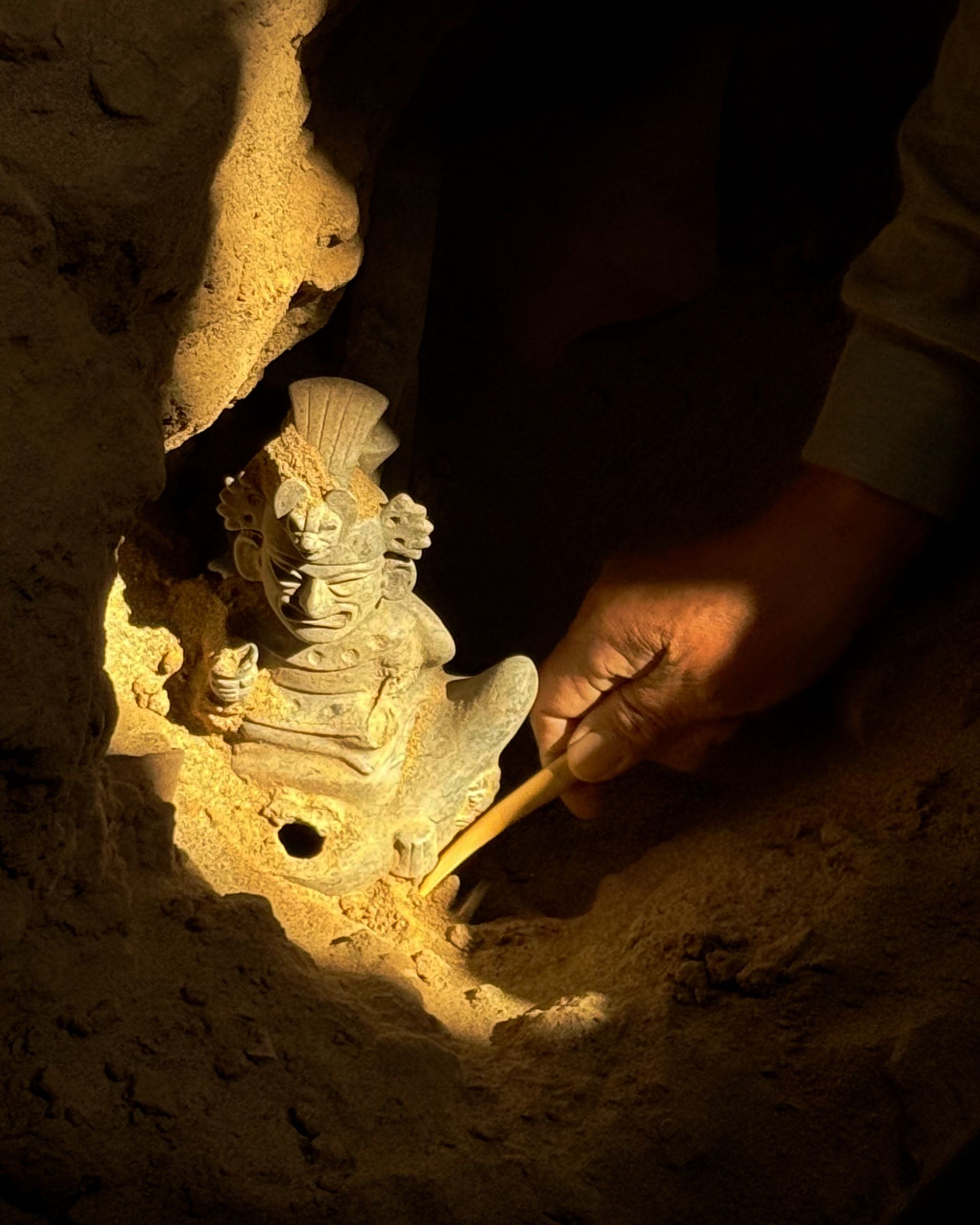 Huacas de Moche Archaeological Project - UNT Huacas de Moche Archaeological Project - UNT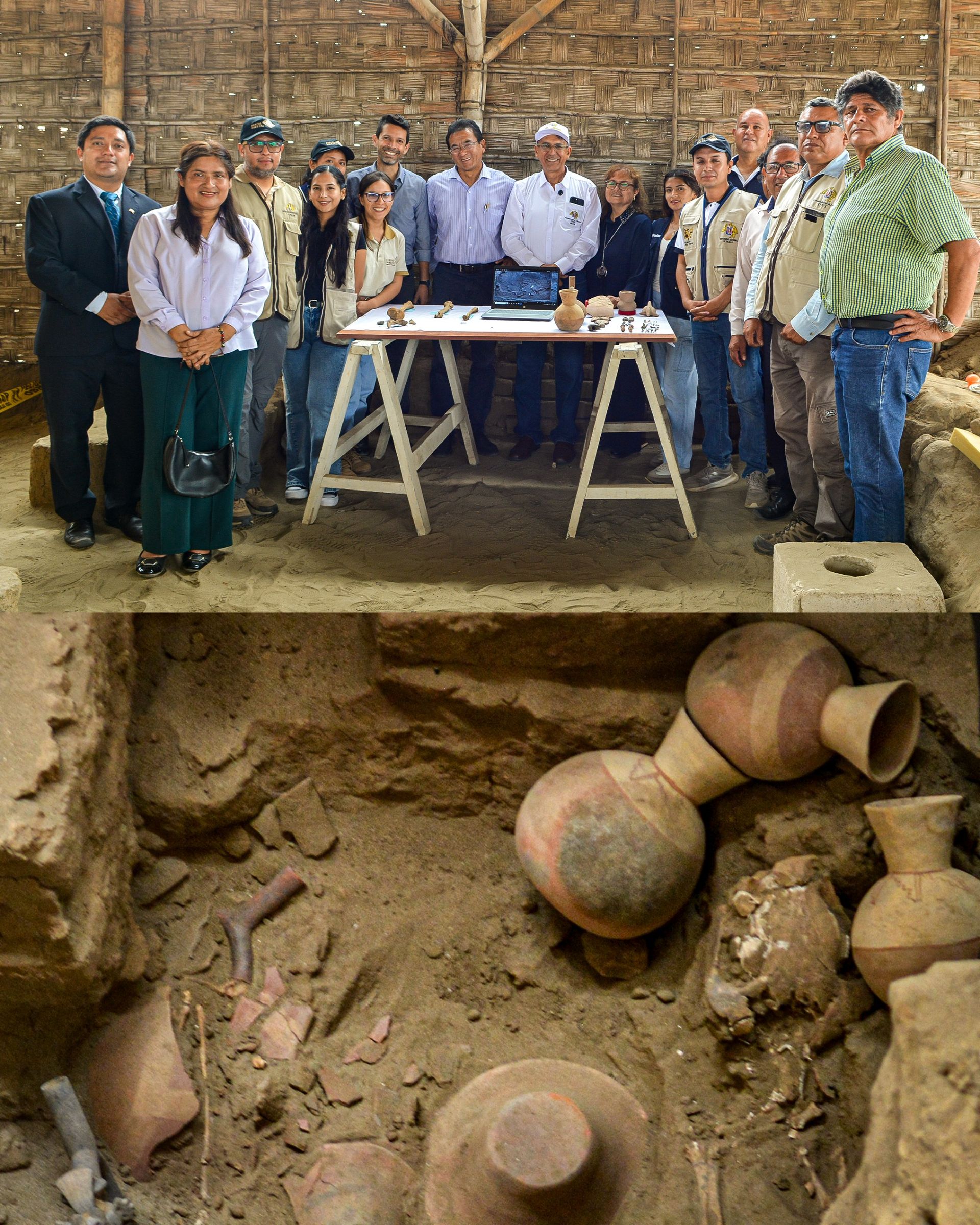 Huacas de Moche Archaeological Project - UNT Huacas de Moche Archaeological Project - UNT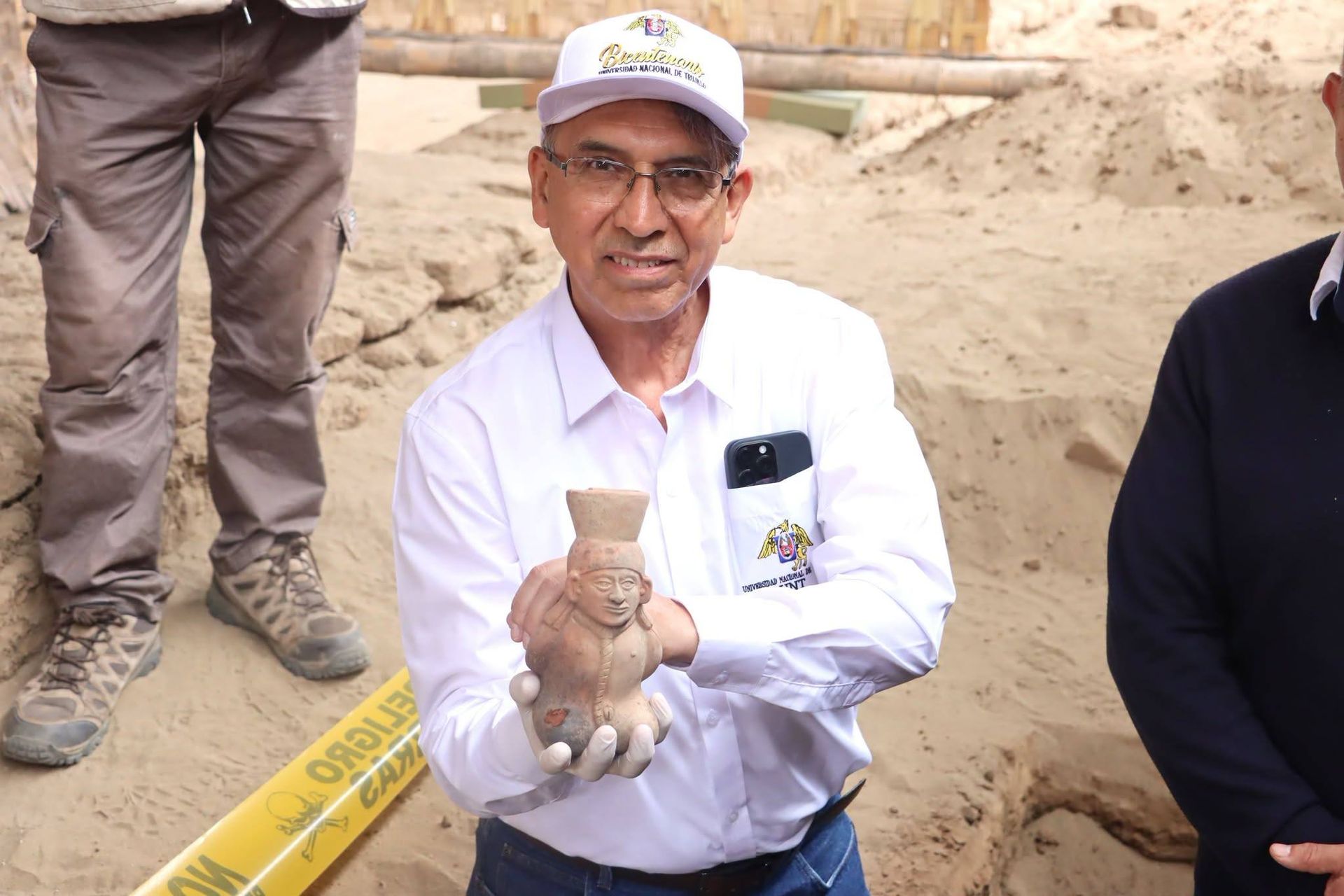 Huacas de Moche Archaeological Project - UNT Huacas de Moche Archaeological Project - UNTBut a toddler couldn't have taken part in such an activity. In general, archaeologists wouldn't expect to see elements of an adult ritual in the burial of a child. "This expands our knowledge on Moche funerary practices," he added. The sculpture of the presumed deity depicts a human body with bird wings and a bird tail, although for some scholars it might be interpreted as a god in transformation, Rengifo-Chunga said. The deity holds a square shield in one hand and a goblet in the other, and is flanked by two bird "assistants" wearing ceremonial garments. Researchers will have to investigate whether the deity is a known Moche god, or a newfound addition to the pantheon. Either way, the object joins a contentious debate over whether the Moche pantheon consists of many gods, or just a few that can transform into many different versions, Rengifo-Chunga said. The artifacts are now in the laboratories of the Santiago Uceda Castillo Museum in Peru, where they will undergo conservation treatment. How much do you know about the first people to reach the Americas? Find out with our First Americans quiz. '> Rare burial of elite toddler from pre-Inca culture discovered in Peru The gold accessory was found in a Bronze Age grave near the town of Mold in Wales. (Image credit: Alamy)QUICK FACTS Name: Mold gold cape What it is: A hammered gold accessory Where it is from: Bryn yr Ellyllon (Goblins' Hill), Wales When it was made: Circa 1900 to 1600 B.C. In 1833, stone quarry workers discovered an ancient burial mound at Goblins' Hill near the town of Mold in Wales. At the center was a stone-lined grave that contained a fragmented skeleton and a gold, cape-like accessory that had been crushed over time. The Mold gold cape has a unique shape and style, and it is one of the finest examples of prehistoric goldwork ever found, according to the British Museum, where the artifact is on display. The cape dates to Britain's Early Bronze Age (2500 to 1200 B.C.), a time that saw a metalworking revolution as artisans shifted from crafting flint tools to making weapons and jewelry out of gold, copper and bronze. When the cape was originally unearthed, experts assumed that it had belonged to an ancient warrior, chief or religious leader, due to the spectacular design of the object, Benjamin Roberts, then curator for the European Bronze Age collections at the British Museum, told the BBC in 2010. But after the broken pieces of the cape were put back together, the small size of the artifact suggested it may have been worn by a woman or a child. The Mold gold cape measures roughly 9.3 inches (23.5 centimeters) tall and 18.3 inches (46.5 cm) wide. It weighs about 1.2 pounds (560 grams) and was probably crafted from a single lump of gold about the size of a ping-pong ball. The gold ingot was beaten incredibly thin, fashioned into a cape, and then embellished with decorations that mimicked beads or necklaces, according to the British Museum. Additionally, several hundred amber beads were found on the cape in the grave, which likely added to the gilded appearance of the accessory. Perforations around the neck opening suggest the cape originally had a lining made of leather or another perishable material that did not survive. Because the gold cape, when worn, would restrict a person's upper arm movements, it may have been a ceremonial accessory that conferred religious authority and was worn only on special occasions. But experts are still unsure why the cape was buried in a grave. Nor can they confirm whether the person it was interred with was male or female, as the skeleton was not recovered by the quarry workers in the 19th century. "The cape is unique — there is really nothing to compare it to in the whole of Europe," Roberts told the BBC. "This makes it more difficult to understand why it was made and what significance it had." For more stunning archaeological discoveries, check out our Astonishing Artifacts archives. Inuit FigurineMaya Death UrnBattersea ShieldCan you put together last week's Astonishing Artifact? '> Mold gold cape: A 3,900-year-old accessory that's one of the finest examples of prehistoric goldwork ever found
Visits
|
Online User :
|
|
|
Today Visit :
|
|
|
Week Visit :
|
|
|
Month Visit :
|
|
|
Total Visit :
|
|
|